
Search engines are one of the main ways people discover websites, products, services, and information online. When someone searches for an answer on Google, thousands or millions of pages may be available. SEO helps a website become more visible in those search results and attract people who are actively looking for relevant information.
But what is SEO, and how does it actually work? For beginners, search engine optimization can seem complicated because it involves keywords, content, technical settings, links, search intent, and many other factors. The good news is that the basic principles are easier to understand than they first appear.
This complete beginner’s guide explains what is SEO in simple language. You will learn what SEO means, how search engines work, why SEO matters, the major types of SEO, keyword research, on-page and technical optimization, backlinks, local SEO, useful SEO tools, common mistakes, and practical SEO tips you can use to improve your website.
Understanding what is SEO is the first step toward building a stronger online presence. Whether you own a business website, blog, online store, or professional website, SEO can help your pages reach people searching for topics related to your content.
In this guide, we will also explain what is SEO from a practical beginner-friendly perspective, including how search engines evaluate websites and what you can do to improve your chances of appearing higher in organic search results.
What Is SEO?
What is SEO? SEO stands for Search Engine Optimization. It is the process of improving a website and its content so search engines can understand, index, and rank its pages more effectively. Understanding what is SEO helps website owners create pages that are easier for search engines and users to find.
When your website follows good SEO practices, it has a better opportunity to appear when people search for topics, products, or services related to your business. This is why learning what is SEO is important for anyone who wants to increase organic traffic and improve their website’s visibility in search results.
For example, imagine you own a digital marketing business and publish an article targeting the search query “SEO services for small businesses.” If the page provides useful information, satisfies search intent, has a strong technical foundation, and earns relevant links, it may become more visible in organic search results. This example makes what is SEO easier to understand because it shows how optimization can connect your content with people actively searching for your services.
SEO is different from paid advertising. With paid search, businesses pay for advertisements that can appear above or around organic results. With SEO, the goal is to earn organic visibility through useful content and website optimization. Now that you understand what is SEO, you can explore how search engines crawl, index, and rank web pages.
What Does SEO Stand For?
SEO stands for Search Engine Optimization.
The three words describe its purpose:
- Search Engine: Platforms such as Google that help users find information.
- Optimization: Improving something so it performs more effectively.
- SEO: Improving a website to increase its visibility in relevant organic search results.
SEO is not about making one change and immediately reaching the first position. It is an ongoing process that combines content quality, technical performance, user experience, authority, and relevance.
Why Is SEO Important?
Understanding what is SEO is important because search engines can send highly relevant visitors to your website. Someone searching for a specific topic, product, or service already has an interest in that subject. This is one of the main reasons what is SEO is an important concept for businesses, bloggers, and website owners.
For a business website, what is SEO can help create opportunities to generate leads, sales, inquiries, subscriptions, or brand awareness. When your website appears in relevant organic search results, you can reach potential customers without paying for every visitor.
Organic search visibility can also provide benefits that continue after a page has been published. A useful article may attract visitors for months or years when it continues to satisfy users and compete effectively in search results. Learning what is SEO helps you understand how consistent optimization can support long-term website growth.
SEO can help you:
- Increase organic website traffic
- Improve online visibility
- Reach people searching for your services
- Build brand credibility
- Generate qualified leads
- Support long-term marketing growth
- Improve website usability
- Compete with larger websites
- Build topical authority
By understanding what is SEO and applying effective optimization strategies, you can improve your website’s ability to attract relevant organic traffic and reach your target audience.
A strong SEO strategy also reduces dependence on a single marketing channel. Instead of relying entirely on paid advertisements, businesses can build an organic traffic source through valuable content and optimization.
How Do Search Engines Work?
To understand SEO, you first need to understand how search engines discover and organize websites.
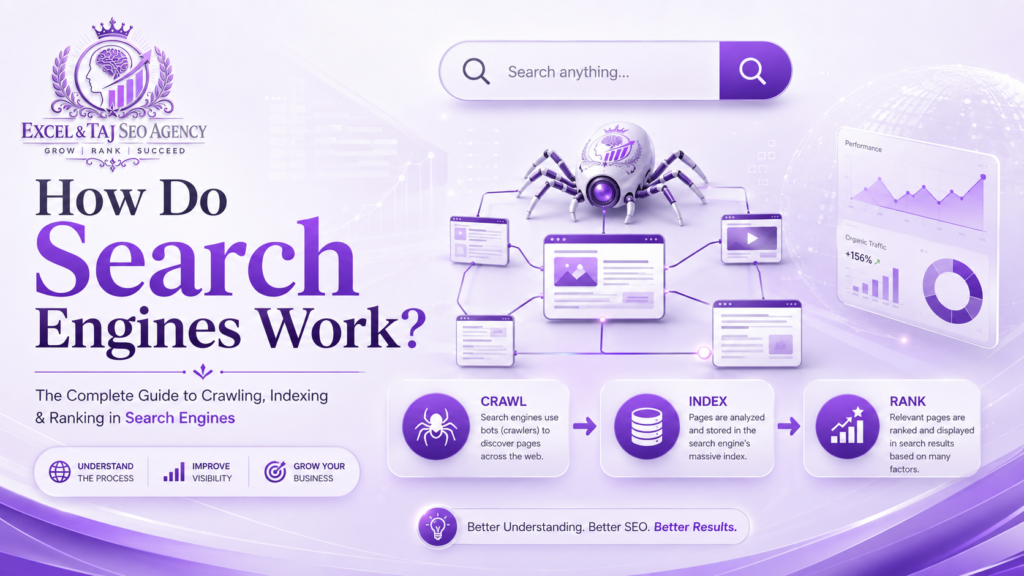
Search engines generally perform three important processes: crawling, indexing, and ranking.
Crawling
Search engine crawlers, sometimes called bots or spiders, discover web pages by following links and accessing available URLs.
A crawler can discover a new page through:
- Internal links
- External links
- XML sitemaps
- Previously known URLs
- Other signals
If a page cannot be accessed properly, search engines may have difficulty discovering its content.
Indexing
After discovering a page, a search engine analyzes its content and determines whether it should be stored in its search index.
The search engine can examine elements such as:
- Page content
- Title
- Images
- Links
- Structured data
- Canonical information
- Language
- Page relationships
Being indexed does not guarantee that a page will rank highly. Indexing simply means the search engine can potentially consider the page for relevant searches.
Ranking
When someone performs a search, understanding what is SEO helps explain how a search engine evaluates potentially relevant pages and orders results according to many signals. Search engines analyze billions of web pages to provide users with the most useful and relevant results.
Relevance, content quality, page experience, authority, context, and other factors can influence visibility. Learning what is SEO helps website owners understand why these factors matter and how they can improve their pages for search engines and users.
When you understand what is SEO, you can create content that matches the search intent behind a user’s query. Search engines aim to provide helpful results, so websites that clearly answer users’ questions can have a better opportunity to gain organic visibility.
This is why understanding what is SEO is more important than simply inserting keywords into a page. Effective SEO focuses on creating useful content, improving website performance, building authority, and providing a positive user experience.
Ultimately, what is SEO comes down to helping search engines understand your content while giving users the information they are looking for. A successful SEO strategy combines relevance, quality, technical optimization, authority, and user satisfaction.
What Are the Main Types of SEO?
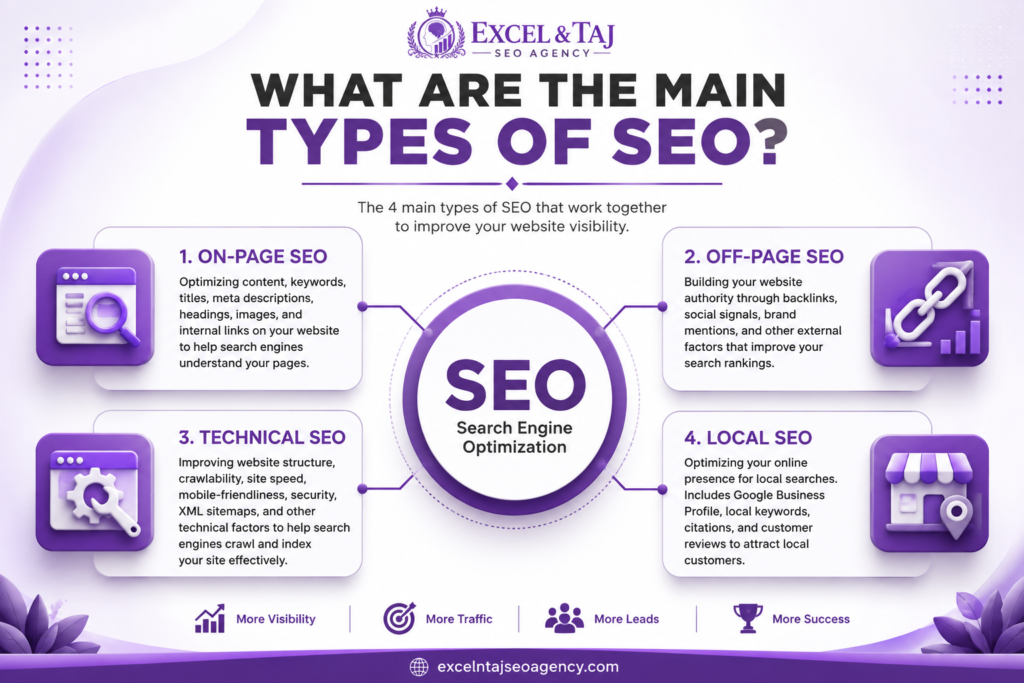
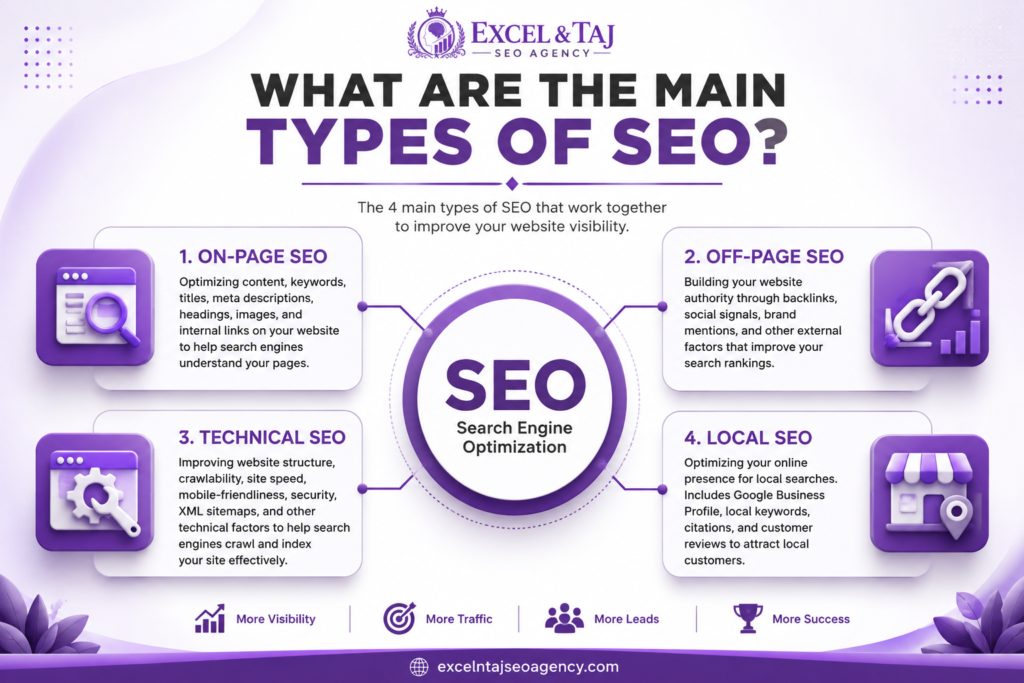
SEO is a broad field. It includes several areas that work together to improve organic search performance.
The most important types include:
- On-page SEO
- Technical SEO
- Off-page SEO
- Local SEO
- Content SEO
- Ecommerce SEO
Let’s examine the major areas.
On-Page SEO
On-page SEO involves optimizing elements that exist on your website and individual pages.
The objective is to help search engines understand the topic while making the page useful and easy to navigate for visitors.
Important on-page elements include:
- Page titles
- Headings
- Content
- Keywords
- Internal links
- URLs
- Image optimization
- Meta descriptions
- Search intent
- Content structure
For example, if your page targets “what is SEO,” the content should clearly explain SEO instead of repeatedly using the exact phrase without providing meaningful information.
Title Tags
The title tag is an important HTML element that describes a page.
A strong title should accurately communicate the subject and encourage the right searchers to click.
For example:
What Is SEO? A Complete Beginner’s Guide to Search Engine Optimization
This title clearly tells users what they can expect from the page.
Meta Descriptions
A meta description summarizes a webpage and may appear beneath the title in search results.
Although meta descriptions are not generally considered a direct ranking factor, a useful description can encourage searchers to click your result.
A good meta description should be:
- Relevant to the page
- Clear and concise
- Written for humans
- Related to the search intent
- Different from descriptions on other pages
Headings
Headings organize content into logical sections.
A good structure usually follows:
H1: Main page topic
H2: Major sections
H3: Subsections within an H2
This structure makes long content easier for readers and search engines to understand.
Keyword Optimization
Keywords are words and phrases that describe what people search for.
Your primary keyword for this guide is What Is SEO.
However, modern SEO is not about repeating one keyword as many times as possible. Search engines have become much better at understanding topics, entities, context, synonyms, and related concepts.
Use keywords naturally where they make sense, especially in:
- The title
- Introduction
- Main headings where appropriate
- Body content
- URL
- Image alt text when descriptive
- Internal links
Avoid keyword stuffing because excessive repetition can make content difficult to read and may create a poor user experience.
Technical SEO
Technical SEO focuses on the technical aspects of a website that help search engines crawl, understand, and access its pages.
Technical optimization can include:
- Website speed
- Mobile usability
- Crawlability
- Indexability
- XML sitemaps
- Robots.txt
- Canonical URLs
- HTTPS
- Redirects
- Broken links
- Structured data
- Core Web Vitals
- Site architecture
You do not need to be an advanced programmer to understand the fundamentals of technical SEO. However, complex technical problems may require assistance from a developer or experienced SEO agency.
Website Speed
Slow websites can frustrate visitors. Improving performance can create a better user experience and help important pages load efficiently.
Common optimization techniques include compressing images, reducing unnecessary scripts, using caching, and improving server performance.
Mobile SEO
Many people access websites through smartphones. A website should therefore work properly across different screen sizes.
Mobile-friendly design should provide:
- Readable text
- Easy navigation
- Properly sized buttons
- Responsive layouts
- Fast loading
- Accessible content
XML Sitemap
An XML sitemap provides search engines with information about important URLs on a website.
It can help search engines discover pages, particularly on larger or more complex websites.
However, having a sitemap does not guarantee that every listed URL will be indexed.
Off-Page SEO
Understanding what is SEO also means knowing how activities outside your own website can influence its authority and visibility. Off-page SEO refers to external signals and activities that can help search engines understand the reputation and credibility of a website.
One of the most well-known areas of off-page optimization is link building. A backlink is a link from another website to your website. When learning what is SEO, it is important to understand that relevant and trustworthy backlinks can demonstrate that other websites consider your content useful and valuable.
However, not every backlink is valuable. Understanding what is SEO means recognizing that the quality, relevance, and authority of backlinks matter more than simply collecting a large number of links.
A strong off-page SEO strategy focuses on earning natural backlinks from reputable and relevant websites. This is an important part of what is SEO because search engines can use external signals to evaluate the authority and trustworthiness of your website.
When you understand what is SEO, you can focus on building genuine authority instead of trying to manipulate search rankings with low-quality links.
What Makes a Good Backlink?
A useful backlink typically comes from a relevant and trustworthy website.
For example, a digital marketing article receiving a natural editorial link from a respected marketing publication is generally more meaningful than hundreds of unrelated links from low-quality pages.
Effective link-building approaches can include:
- Publishing original research
- Creating useful resources
- Digital PR
- Expert contributions
- Relevant guest content
- Building relationships within your industry
Avoid manipulative link schemes designed solely to influence rankings.
Local SEO
Local SEO helps businesses become more visible for searches connected to a specific geographic area.
It is especially important for businesses that serve customers at physical locations or within defined service areas.
Examples include:
- Restaurants
- Hotels
- Dentists
- Lawyers
- Plumbers
- Local retailers
- Marketing agencies
- Medical practices
A local SEO strategy may involve optimizing your Google Business Profile, maintaining consistent business information, creating location-relevant content, earning local mentions, and collecting legitimate customer reviews.
For example, a marketing agency targeting customers in a particular city can create useful location-specific pages and optimize its business profile for relevant local searches.
What Is Keyword Research?
Keyword research is the process of identifying the terms and questions people use when searching online.
It is one of the foundations of an effective SEO strategy.
Instead of creating content based only on assumptions, keyword research helps you understand what your potential audience actually searches for.
Types of Keywords
Keywords can be categorized in several ways.
Short-tail keywords are broad phrases such as “SEO.”
Long-tail keywords are more specific, such as “what is SEO for beginners.”
Long-tail searches often have lower search volume but can provide clearer search intent.
You can also classify keywords according to intent:
- Informational
- Navigational
- Commercial
- Transactional
Understanding intent is essential because the best page format depends on what the searcher wants.
Someone searching “what is SEO” probably wants an explanation. Someone searching “SEO agency near me” may be looking for a service provider.
How to Choose the Right Keywords
When selecting keywords, consider more than search volume.
Look at:
- Search intent
- Relevance
- Competition
- Business value
- Search volume
- Content opportunities
- Existing search results
The ideal keyword is one that matches your audience and the purpose of your website.
For TajSeoAgency, relevant topics can include SEO tips, SEO services, SEO tools, technical optimization, content marketing, and local search optimization.
What Are SEO Tools?
SEO tools help marketers analyze websites, keywords, rankings, backlinks, competitors, technical issues, and content opportunities.
Different tools serve different purposes.
Common categories include:
Keyword Research Tools
These tools help identify keyword ideas, search demand, competition, and related queries.
Website Audit Tools
Website crawlers can identify technical problems such as:
- Broken links
- Missing metadata
- Duplicate pages
- Redirect issues
- Crawl problems
Backlink Tools
Backlink platforms help analyze the links pointing to your website and sometimes those of competitors.
Performance Tools
Tools such as Google Search Console can provide information about search queries, impressions, clicks, indexing, and website performance in Google Search.
Using tools is helpful, but tools should support your strategy rather than replace judgment.
How to Create an Effective SEO Strategy
A successful SEO strategy begins with understanding your business and audience.
Start by defining what you want organic search to accomplish.
For example, your goal might be to generate more qualified leads for your SEO services.
Then follow a structured process.
Step 1: Understand Your Audience
Identify who you want to reach.
Think about their problems, questions, goals, location, and purchasing stage.
Step 2: Research Relevant Keywords
Find the searches your audience uses and group them according to topic and intent.
Step 3: Analyze Competitors
Study pages that currently rank for your target topics.
Look at their content structure, topics, backlinks, user experience, and weaknesses.
Do not simply copy competitors. Find opportunities to create something more useful or more complete.
Step 4: Create Helpful Content
Develop original content that directly answers the user’s question.
Good content should demonstrate knowledge, provide practical information, and avoid unnecessary filler.
Step 5: Optimize Your Pages
Improve titles, headings, URLs, internal links, images, content structure, and other relevant on-page elements.
Step 6: Improve Technical SEO
Check crawling, indexing, mobile usability, page performance, security, redirects, and site architecture.
Step 7: Build Authority
Promote genuinely useful content and earn relevant mentions and backlinks.
Step 8: Measure Results
Track organic clicks, impressions, rankings, conversions, and other meaningful SEO metrics.
Then use the data to improve your strategy.
SEO Tips for Beginners
If you are new to search engine optimization, focus on fundamentals before complicated tactics.
Here are practical SEO tips to get started:
- Create content for people first.
- Understand search intent before writing.
- Target relevant keywords instead of random high-volume terms.
- Use clear and descriptive page titles.
- Organize articles with logical headings.
- Add useful internal links.
- Make your website mobile-friendly.
- Fix important technical issues.
- Optimize images without reducing useful quality.
- Earn relevant backlinks naturally.
- Keep important information accurate and updated.
- Monitor your organic performance regularly.
SEO is a long-term process. Avoid strategies that promise instant first-page rankings.
What Is an SEO Agency?
An SEO agency is a company that provides search engine optimization services to businesses and organizations.
An agency may help with:
- Keyword research
- Content strategy
- On-page optimization
- Technical SEO
- Link building
- Local SEO
- Competitor research
- SEO audits
- Performance reporting
Businesses often work with agencies when they do not have the time, expertise, or internal resources to manage SEO themselves.
What Is an SEO Company?
An SEO company provides professional services designed to improve a website’s organic search visibility.
The terms SEO agency and SEO company are often used interchangeably. What matters most is the quality of the strategy, communication, experience, and results rather than the label.
Before hiring a provider, evaluate its:
- Previous work
- SEO methodology
- Reporting process
- Communication
- Pricing structure
- Understanding of your industry
- Approach to link building
- Expectations about timelines
Be cautious of providers that guarantee a specific Google ranking. Search rankings depend on many variables, and no legitimate provider can control Google’s results.
What Are SEO Services?
Understanding what is SEO also helps you understand what professional SEO services actually involve. SEO services are professional activities performed to improve a website’s visibility in organic search and help it reach the right audience.
When learning what is SEO, it is useful to know that SEO providers may offer different services depending on a business’s needs. These services can include technical audits, keyword research, content optimization, local SEO, link building, competitor analysis, and ongoing performance monitoring.
If you are comparing SEO providers, understanding what is SEO can help you evaluate whether their services match your actual business objectives. A reliable SEO provider should focus on strategies that improve both search visibility and the overall performance of your website.
A good SEO campaign should connect search visibility with meaningful business outcomes rather than focusing only on rankings. Knowing what is SEO allows businesses to look beyond rankings and consider important results such as organic traffic, qualified leads, conversions, and revenue.
Ultimately, what is SEO is about improving a website’s ability to be discovered by relevant users while providing valuable information and a positive experience.
Common SEO Mistakes to Avoid
Beginners often make SEO more complicated than necessary.
Some common mistakes include:
Keyword Stuffing
Repeating the same keyword unnaturally can make content difficult to read.
Publishing Thin Content
A short page is not automatically bad, but content that provides little value is unlikely to satisfy users.
Ignoring Search Intent
A page may target the right keyword but still perform poorly if it does not provide the information searchers expect.
Buying Low-Quality Backlinks
Large quantities of irrelevant or manipulative links can create risks instead of building genuine authority.
Ignoring Technical Problems
Excellent content cannot perform at its full potential if search engines cannot properly access or understand the website.
Focusing Only on Rankings
Rankings matter, but traffic quality, leads, sales, engagement, and conversions are often more important business outcomes.
How Long Does SEO Take to Work?
SEO does not have one guaranteed timeline.
Results can depend on factors such as:
- Website age
- Competition
- Industry
- Content quality
- Technical condition
- Website authority
- Search intent
- Backlink profile
- Search demand
- Consistency of optimization
Some pages can gain visibility relatively quickly, while competitive topics may require much more time and resources.
Instead of expecting instant results, treat SEO as a continuous investment.
SEO vs. Paid Search
SEO and paid search can both bring visitors from search engines, but they work differently.
With SEO, you optimize your website to earn organic visibility.
With paid search, you pay for advertising placements based on an advertising platform’s system.
SEO can create lasting organic visibility, while paid campaigns can provide traffic quickly while the advertising budget is active.
Many businesses use both approaches because they can complement each other.
What Is the Future of SEO?
Search is continuously changing. Search engines increasingly understand natural language, context, entities, and user intent.
Artificial intelligence is also changing how people discover information and interact with search systems.
For SEO professionals, this means creating genuinely useful content is becoming even more important.
Successful websites should focus on:
- Helpful information
- First-hand expertise
- Clear organization
- Strong technical foundations
- Good user experience
- Original insights
- Accurate information
- Sustainable promotion
Rather than trying to manipulate algorithms, businesses should build websites that deserve to be discovered.
Frequently Asked Questions About SEO
What is SEO in simple words?
SEO is the process of improving a website so search engines can understand it and users can find it through relevant organic searches. It includes content, keywords, technical optimization, links, and user experience.
Is SEO free?
Organic SEO does not require paying Google for each click. However, SEO can require investment in content, tools, professional expertise, development, and promotion.
How long does SEO take?
There is no universal timeline. Results depend on competition, website authority, technical health, content quality, search intent, and many other factors. SEO generally requires consistent effort over time.
What are the most important SEO factors?
There is no single factor that guarantees rankings. Important areas include helpful and relevant content, search intent, technical accessibility, website architecture, internal linking, authority, and overall user experience.
Can beginners learn SEO?
Yes. Beginners can learn SEO by understanding search engines, keyword research, on-page optimization, technical fundamentals, content strategy, links, and analytics. Starting with the fundamentals is usually more effective than trying advanced tactics immediately.
Conclusion
So, what is SEO? Search Engine Optimization is the practice of improving a website so search engines can discover, understand, and potentially rank its pages for relevant searches.
SEO combines content, keywords, technical optimization, internal links, authority, user experience, and ongoing analysis. It is not a shortcut to instant rankings. Instead, it is a long-term strategy for building sustainable organic visibility.
If you are starting from scratch, focus on understanding your audience, researching relevant search terms, creating genuinely helpful content, maintaining a technically healthy website, and measuring meaningful results. Use SEO tools to support your decisions, but always prioritize users over algorithms.
For businesses that need professional assistance, working with an experienced SEO agency can provide additional expertise and resources. With the right strategy and consistent execution, SEO can become an important channel for attracting qualified visitors and growing an online business.