
Search engines are one of the most powerful sources of online traffic for businesses, bloggers, ecommerce stores, and service providers. Every day, people search for products, services, answers, and solutions on Google and other search engines. SEO helps your website become more visible when potential customers search for topics related to your business.
But getting traffic is not the only goal. A successful strategy should also attract the right visitors, improve Google rankings, generate qualified leads, and ultimately increase sales.
This complete guide explains how SEO works, why it matters, and how you can use proven optimization techniques to improve organic traffic and business growth. You will learn about keyword research, on-page SEO, technical SEO, content optimization, link building, local SEO, SEO tools, common mistakes, and practical strategies for building long-term search visibility.
Whether you are a beginner or already have some experience with search engine optimization, this guide will help you create a more effective SEO strategy.
What Is SEO?
SEO, or Search Engine Optimization, is the process of improving a website and its content so search engines can understand, index, and rank its pages for relevant searches.
When someone searches for a phrase on Google, the search engine analyzes many potentially relevant pages. It then presents results based on relevance, quality, usefulness, authority, and other signals.
For example, if someone searches for SEO services, Google may display agencies, companies, guides, and service pages that best match the searcher’s intent.
The goal of SEO is not simply to place keywords on a webpage. Modern optimization involves creating useful content, improving technical performance, satisfying search intent, building authority, and providing a good experience for visitors.
Why Is SEO Important for a Website?
A website can look professional and still receive very little organic traffic if potential customers cannot find it.
SEO helps bridge that gap.
A strong strategy can help you:
- Increase organic traffic
- Improve search visibility
- Reach relevant audiences
- Generate qualified leads
- Increase online sales
- Build brand awareness
- Improve website usability
- Establish industry authority
- Reduce dependence on paid advertising
Unlike an advertisement that stops producing traffic when its budget ends, a well-optimized page can continue attracting organic visitors after publication.
How Does SEO Work?
Search engines generally discover and process websites through three major stages: crawling, indexing, and ranking.
Crawling
Search engine crawlers discover webpages by following links and accessing URLs that they can reach.
A crawler may discover a page through internal links, external links, XML sitemaps, or previously discovered URLs.
If important pages are difficult to access, search engines may have trouble discovering them.
Indexing
After crawling a webpage, a search engine analyzes its content and decides whether the page should be included in its index.
The search engine can analyze information such as:
- Text and headings
- Images
- Links
- Page relationships
- Structured data
- Canonical information
- Language and topic
A page being indexed does not guarantee that it will rank highly.
Ranking
When a user performs a search, the search engine identifies pages that may satisfy the query and orders them according to many signals.
Relevance, content quality, authority, usability, context, and other factors can affect search visibility.
This is why effective SEO focuses on satisfying users instead of trying to manipulate search engines.
How to Create an Effective SEO Strategy
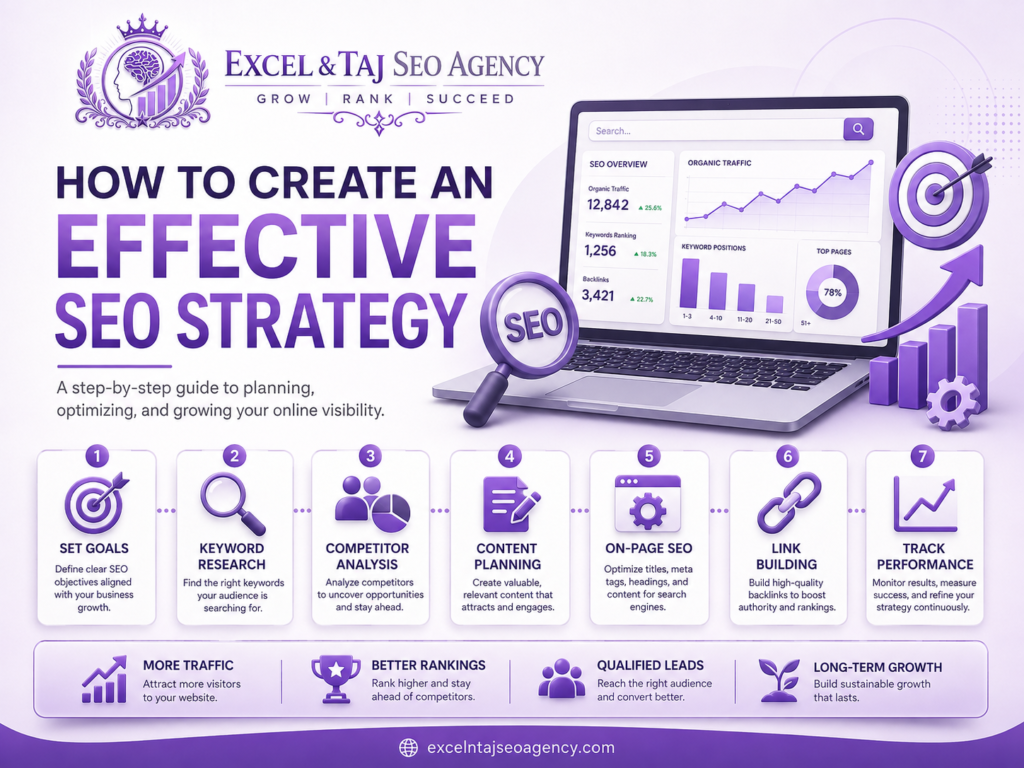
A successful strategy starts with your business goals and audience.
Before publishing dozens of articles, determine what you want organic search to accomplish.
Your goals might include increasing:
- Website traffic
- Product purchases
- Service inquiries
- Phone calls
- Email leads
- Brand searches
- Local customers
Once your goal is clear, you can create an optimization strategy around relevant search demand.
Keyword Research
Keyword research is the process of discovering the words and phrases people use in search engines.
It is one of the most important parts of an SEO campaign because keywords help you understand what your audience wants to find.
For example, a person searching for:
“what is SEO”
has a primarily informational intent.
Someone searching for:
“SEO agency near me”
has a stronger commercial or local intent.
Someone searching for:
“buy SEO software”
has transactional intent.
Understanding these differences helps you create the right content for the right audience.
Types of Keywords
Keywords can be categorized into several groups.
Short-tail keywords are broad terms such as “SEO” or “digital marketing.”
Long-tail keywords are more specific phrases such as “SEO strategy for small businesses.”
Long-tail keywords often have lower search volume, but they can provide highly targeted traffic because the user’s intent is clearer.
Other useful keyword categories include:
- Informational keywords
- Commercial keywords
- Transactional keywords
- Navigational keywords
- Local keywords
- Branded keywords
How to Choose the Right Keywords
Do not choose keywords only because they have high search volume.
Consider:
- Search intent
- Relevance to your business
- Competition
- Potential traffic
- Conversion potential
- Audience needs
- Existing search results
The best keyword is often one that matches your website’s expertise and business objectives.
On-Page SEO
On-page SEO involves optimizing individual webpages to make their content easier for search engines and users to understand.
It includes content, headings, title tags, URLs, internal links, images, metadata, and search intent.
Optimize Your Page Title
The title tag tells search engines and users what a page is about.
For this article, a strong title is:
SEO: The Complete Guide to Increase Traffic, Rankings & Sales
It includes the main keyword naturally while communicating the benefit of the article.
A good title should be:
- Relevant
- Descriptive
- Concise
- Unique
- Appealing to searchers
Avoid repeating the same keyword several times in a title.
Create Useful Meta Descriptions
A meta description provides a short summary of the webpage.
A suitable description for this article could be:
Learn SEO strategies to increase organic traffic, improve Google rankings, attract qualified visitors, and grow online sales with this complete guide.
A useful meta description should explain what users can expect after clicking.
Use a Clear Heading Structure
A logical heading hierarchy improves readability and content organization.
A typical structure is:
H1 → H2 → H3
The H1 represents the main topic. H2 headings cover major sections, while H3 headings explain specific subsections.
Avoid jumping randomly between heading levels.
Optimize Your Content
Your content should answer the user’s question completely.
Instead of writing for keyword density, write naturally around the topic.
Include relevant concepts, examples, related questions, and useful information.
For example, an article about SEO can naturally discuss:
- Search engines
- Google rankings
- Organic traffic
- Keyword research
- Search intent
- Content marketing
- Technical SEO
- Backlinks
- Local search
- SEO analytics
This creates topical depth without unnecessary keyword repetition.
Technical SEO
Technical SEO focuses on improving the technical foundation of a website so search engines can crawl, understand, and access its pages efficiently.
Technical optimization can include:
- Website speed
- Mobile usability
- HTTPS
- XML sitemaps
- Robots.txt
- Canonical URLs
- Redirects
- Broken links
- Structured data
- Crawlability
- Indexability
- Core Web Vitals
Technical SEO is especially important for large websites with thousands of pages, ecommerce stores, and websites with complicated structures.
Improve Website Speed
Website performance affects user experience.
Visitors are more likely to leave when a page takes too long to load. Improving performance can therefore support both usability and overall website quality.
You can improve speed by:
- Compressing large images
- Removing unnecessary scripts
- Using browser caching
- Optimizing code
- Improving hosting performance
- Reducing excessive third-party resources
Do not optimize speed by sacrificing important content or functionality.
Make Your Website Mobile-Friendly
Many searches happen on smartphones.
Your website should work properly across different screen sizes and provide an easy mobile experience.
Check that:
- Text is easy to read
- Buttons are easy to tap
- Menus work correctly
- Images fit the screen
- Content does not require horizontal scrolling
- Important information is easy to access
A responsive website is an essential part of modern search optimization.
Content SEO
High-quality content is one of the foundations of a successful SEO strategy.
Search engines aim to provide useful results to users. Therefore, websites that consistently publish helpful, relevant, and trustworthy content can create stronger opportunities for organic visibility.
Write for Search Intent
Search intent means the reason behind a search query.
A user might want to:
- Learn something
- Compare products
- Find a specific website
- Buy something
- Contact a service provider
- Find a local business
Before writing an article, search your target keyword and examine the types of pages appearing in the results.
If most results are beginner guides, creating a highly technical sales page may not satisfy the same intent.
Build Topic Clusters
Instead of publishing unrelated articles, create groups of content around important topics.
For example, a website focused on digital marketing might have a main SEO guide supported by articles about:
- Keyword research
- On-page SEO
- Technical SEO
- Local SEO
- Link building
- SEO audits
- Content optimization
- Google Search Console
- SEO analytics
Internal links can connect these pages and help users discover related information.
Off-Page SEO and Link Building
Off-page SEO refers to activities outside your website that can contribute to authority and visibility.
One major area is link building.
A backlink is a link from another website to your website. Relevant, editorially earned links can help demonstrate that your content is useful or noteworthy.
However, quality matters more than quantity.
How to Build Quality Backlinks
Effective link-building methods can include:
- Creating original research
- Publishing useful resources
- Digital PR
- Industry contributions
- Creating link-worthy guides
- Building professional relationships
- Earning editorial mentions
Avoid purchasing large quantities of low-quality links or participating in manipulative link schemes.
A natural backlink profile is built around useful content and legitimate relationships.
Local SEO
Local SEO focuses on improving visibility for searches connected to a specific geographic location.
It is especially valuable for businesses that serve customers in particular cities or areas.
Examples include:
- Restaurants
- Hotels
- Dentists
- Lawyers
- Contractors
- Retail stores
- Marketing agencies
- Local service businesses
How to Improve Local SEO
A local optimization strategy can include:
- Creating and maintaining a Google Business Profile
- Keeping business information accurate
- Building relevant local citations
- Publishing location-specific content
- Earning legitimate customer reviews
- Creating useful location pages
- Building relevant local links
For example, a marketing agency serving a particular city can create content around local business marketing challenges and optimize its business profile for relevant searches.
SEO for Small Businesses
Small businesses often compete against larger companies with bigger marketing budgets.
A focused SEO strategy can help smaller websites compete for highly relevant searches.
Instead of targeting extremely broad terms immediately, focus on topics that closely match your products, services, location, and customers.
For example, a small business may benefit more from ranking for a specific service-related search than from attempting to rank immediately for an extremely broad term such as “marketing.”
Create useful content, optimize important service pages, build local authority, and consistently improve your website.
SEO for Ecommerce Websites
Ecommerce SEO focuses on improving the visibility of product and category pages.
Important elements include:
- Product titles
- Product descriptions
- Category structure
- Internal linking
- Product images
- Structured data
- Technical performance
- Reviews
- Faceted navigation
- Duplicate content management
Each important product should provide useful and unique information rather than relying entirely on manufacturer descriptions.
Strong category pages can also target broader commercial searches and guide users toward relevant products.
SEO Tools You Can Use
The right SEO tools can make research and analysis much easier.
Different tools are designed for different tasks.
Google Search Console
Google Search Console provides information about your website’s performance in Google Search.
It can help you monitor:
- Search queries
- Clicks
- Impressions
- Average positions
- Indexing issues
- Search appearance
- Website-related reports
Google Analytics
Analytics tools help you understand how visitors interact with your website.
You can examine traffic sources, engagement, conversions, and other useful performance data.
Keyword Research Platforms
Keyword research platforms can provide keyword suggestions, search volume estimates, competition information, and related queries.
Use these tools as research aids rather than treating every metric as an absolute fact.
Website Audit Tools
Technical auditing tools can identify issues involving:
- Broken links
- Missing metadata
- Duplicate content
- Redirects
- Crawlability
- Internal linking
- Page performance
The best tool is the one that helps you make better decisions.
How to Increase Organic Traffic With SEO
Increasing organic traffic requires more than publishing content.
Start by identifying pages that already receive impressions but have room to improve.
For example, a page may appear frequently in search results but receive relatively few clicks. Improving its title and content relevance may increase its click-through performance.
You can also:
- Update outdated content
- Expand thin sections
- Improve internal links
- Target related search queries
- Fix technical issues
- Improve page experience
- Earn relevant backlinks
- Create supporting content
Regular optimization can be more effective than continuously publishing new pages without reviewing existing content.
How SEO Can Increase Sales
Traffic alone does not guarantee revenue.
The visitors reaching your website should have a reason to take action.
Your SEO strategy should therefore connect search intent with business goals.
For example, an informational article can introduce a topic and internally link readers to a relevant service page.
A commercial page can explain your solution, demonstrate expertise, answer objections, and provide a clear call to action.
To turn organic visitors into customers, focus on:
- Relevant traffic
- Strong landing pages
- Clear offers
- Trust signals
- Easy navigation
- Strong calls to action
- Simple contact processes
- Helpful product information
This is how SEO moves beyond rankings and becomes part of a complete digital marketing strategy.
SEO Metrics You Should Track
Tracking the right metrics helps you determine whether your strategy is working.
Important SEO metrics can include:
- Organic clicks
- Organic impressions
- Keyword visibility
- Average search position
- Organic conversions
- Leads
- Revenue
- Click-through rate
- Engaged sessions
- Indexed pages
Do not judge SEO success from rankings alone.
A keyword ranking in position one is not particularly valuable if it produces no relevant traffic or conversions.
Business outcomes should remain central to your strategy.
How to Perform an SEO Audit
An SEO audit is a systematic review of a website’s search optimization.
A basic audit can examine:
Technical Issues
Check crawling, indexing, redirects, HTTPS, mobile usability, page speed, and broken links.
On-Page Optimization
Review titles, headings, URLs, metadata, content quality, images, and internal links.
Content
Identify outdated, duplicate, thin, or poorly targeted pages.
Backlinks
Review your backlink profile and identify potentially harmful or irrelevant patterns.
Competitors
Analyze competing websites to discover content gaps and opportunities.
An audit gives you a clearer understanding of what should be fixed first.
Common SEO Mistakes to Avoid
SEO can become ineffective when businesses focus on shortcuts instead of sustainable strategies.
Avoid these common mistakes:
Keyword Stuffing
Repeating the same keyword excessively makes content unnatural and provides little additional value.
Publishing Low-Quality Content
Creating hundreds of weak articles is not a replacement for useful, comprehensive content.
Ignoring Search Intent
A page should match what the searcher expects to find.
Buying Spammy Backlinks
Low-quality link schemes can create unnecessary risks.
Ignoring Technical SEO
Important pages need to be accessible, crawlable, and technically sound.
Using Duplicate Content
Large amounts of substantially duplicated content can make it harder for search engines to understand which pages deserve visibility.
Focusing Only on Rankings
SEO should contribute to traffic, leads, sales, and business growth.
White Hat SEO vs. Black Hat SEO
White hat SEO focuses on sustainable optimization methods that prioritize useful content, good user experience, and legitimate authority.
Black hat SEO refers to manipulative tactics designed to exploit search engine systems.
Examples of risky practices can include:
- Keyword stuffing
- Cloaking
- Hidden text
- Manipulative link schemes
- Automatically generated low-value pages
For a long-term website, sustainable optimization is the better approach.
Your goal should be to build a website that users genuinely want to visit and recommend.
How Long Does SEO Take?
There is no universal timeframe for SEO results.
The time required can depend on:
- Website authority
- Competition
- Industry
- Content quality
- Technical condition
- Search demand
- Existing backlinks
- Website history
- Optimization consistency
Some pages can gain visibility relatively quickly, while competitive topics may require months of consistent work.
Avoid anyone who guarantees a specific Google ranking within an exact number of days.
SEO is an ongoing process rather than a one-time task.
Choosing an SEO Agency or SEO Company
If you do not have the time or expertise to manage SEO internally, you may consider working with an SEO agency or SEO company.
Before choosing a provider, examine its approach carefully.
Look for:
- Clear strategy
- Transparent communication
- Realistic expectations
- Relevant experience
- Useful reporting
- Ethical optimization methods
- Understanding of your industry
- Focus on business outcomes
A professional SEO provider should be able to explain what it plans to improve and why those improvements matter.
For businesses looking for professional guidance, TajSeoAgency can be used as the website’s relevant SEO resource and service destination.
Practical SEO Tips for Better Results
If you want to improve your website’s organic performance, start with the fundamentals.
Here are practical SEO tips you can apply:
- Research your audience before choosing keywords.
- Match every page with a clear search intent.
- Create original and genuinely useful content.
- Use your primary keyword naturally.
- Include relevant related terms without forcing them.
- Write descriptive titles and headings.
- Improve internal linking between related pages.
- Keep important pages technically accessible.
- Optimize images and website performance.
- Make your website mobile-friendly.
- Earn relevant and trustworthy backlinks.
- Update important content when information changes.
- Monitor performance using reliable data.
- Focus on conversions, not rankings alone.
- Avoid shortcuts that could damage your website.
The Future of SEO
Search is constantly evolving.
Search engines increasingly understand natural language, context, entities, relationships, and user intent. Artificial intelligence is also changing how people search for information and discover businesses.
This does not make SEO irrelevant. Instead, it makes useful content and strong website fundamentals even more important.
Businesses should focus on creating:
- Original insights
- Helpful content
- Accurate information
- Strong user experiences
- Clear website structures
- Demonstrable expertise
- Technically accessible pages
The future belongs to websites that provide genuine value rather than pages created only to manipulate rankings.
Frequently Asked Questions About SEO
What is SEO and why is it important?
SEO stands for Search Engine Optimization. It involves improving a website so search engines can understand and rank its pages for relevant searches. It is important because organic visibility can bring qualified visitors, leads, and sales.
How long does SEO take to show results?
SEO does not have a fixed timeline. Results depend on competition, website authority, technical health, content quality, backlinks, and consistency. Some pages may gain visibility relatively quickly, while competitive topics can require much longer.
Is SEO better than paid advertising?
SEO and paid advertising serve different purposes. Paid advertising can generate traffic quickly, while SEO focuses on building organic visibility over time. Many businesses use both strategies together.
Can I do SEO myself?
Yes. Beginners can learn keyword research, on-page optimization, content SEO, internal linking, and basic technical SEO. More complex websites may benefit from professional SEO services.
What are the most important SEO factors?
There is no single factor that guarantees rankings. Important areas include relevant and helpful content, search intent, technical accessibility, website structure, internal linking, authority, and overall user experience.
Conclusion
SEO is much more than adding keywords to a webpage. It is a complete process that combines content, technical optimization, keyword research, search intent, internal linking, authority, user experience, and performance analysis.
A successful SEO strategy should help search engines understand your website while giving visitors exactly what they need. When these elements work together, your website can build stronger organic visibility, attract more relevant traffic, and create more opportunities for leads and sales.
Start with the fundamentals. Research the right keywords, create useful content, optimize important pages, improve technical performance, build legitimate authority, and monitor your results.
Most importantly, do not focus only on ranking for keywords. Focus on attracting the right audience and turning organic visibility into meaningful business results.
With consistent optimization and a user-first approach, SEO can become a powerful long-term channel for increasing traffic, improving rankings, and growing your business.
Pingback: SEO Guide 2026