
Search engine optimization has changed dramatically, but the goal of SEO in 2026 is still simple: help the right people discover useful, trustworthy content when they search. What has changed is the search experience itself. Google now combines traditional organic results with AI Overviews, AI Mode, richer visual results, local features, shopping results, videos, and other formats.
That means ranking higher is no longer only about getting one blue link into the top ten. Modern SEO is about building a website Google can crawl, understand, trust, and confidently surface across multiple search experiences. Google continues to recommend people-first content and warns against tactics designed mainly to manipulate rankings.
This guide explains how businesses and website owners can approach SEO in 2026 without relying on shortcuts, outdated tactics, or unnecessary keyword stuffing.
What SEO Means in 2026
SEO is the process of improving a website so search engines can discover, understand, index, and present its pages to relevant users.
Google describes Search as a system that broadly moves through crawling, indexing, and serving results. If your website has problems at any of these stages, even excellent content can struggle to perform.
The biggest difference in 2026 is that search is more varied. A user may receive a standard search results page, an AI-generated summary, a local map result, product information, images, videos, or a combination of several formats.
Google says the same core SEO best practices remain relevant to its AI features, which means businesses do not need to invent a completely separate optimization strategy for AI search.
A successful SEO strategy should connect four major areas: search intent, content quality, technical performance, and website authority.
Start With Search Intent, Not Just Keywords
Keyword research remains an essential part of SEO, but choosing keywords only because they have high search volume is outdated.
Every keyword represents a need.
Someone searching for “SEO” may simply want to understand what search engine optimization means. A person searching for “SEO agency for small business,” however, is probably much closer to hiring a professional service.
Similarly, “technical SEO checklist” suggests informational intent, while “technical SEO services” has much stronger commercial intent.
Before creating a page, determine what the searcher actually expects to find.
Search intent normally falls into categories such as:
- Informational
- Commercial
- Transactional
- Local
- Navigational
Your page should then be created around that purpose.
Good keyword research in 2026 should consider primary and secondary keywords, related entities, recurring questions, search intent, commercial value, location modifiers, and competitor coverage.
The objective is not to repeat the focus keyword as many times as possible. It is to build the most useful page for the meaning behind that keyword.
Create Helpful Content With Real Experience
Content remains central to SEO, but generic articles are becoming easier to produce and easier for users to ignore.
Google recommends creating content primarily for people instead of publishing pages mainly to attract search engine traffic. Its guidance also encourages website owners to make it clear who created content, how it was produced, and why it exists.
This changes what “high-quality SEO content” should look like.
A useful article should do more than summarize the same information already available on competing websites. Try to add something original, such as:
- First-hand experience
- Real examples
- Original screenshots
- Case studies
- Expert observations
- Comparisons
- Research
- Data
- Tested processes
- Lessons learned from real projects
The goal is to give readers a reason to choose your content rather than another page covering the same topic.
E-E-A-T—experience, expertise, authoritativeness, and trustworthiness—is useful as a quality framework, but Google explicitly says E-E-A-T itself is not a single ranking factor. Trust is particularly important, which makes accurate information, transparent authorship, credible sources, and legitimate business details valuable.
Optimize On-Page SEO Naturally
On-page SEO helps Google understand what an individual page is about while also making the content easier for visitors to read.
Start with a clear title, a descriptive H1, and helpful H2 and H3 headings. Write an attractive meta description for humans, recognizing that Google may sometimes generate a different snippet depending on the user’s query.
Your primary keyword should appear naturally in important places such as:
- SEO title
- Main heading
- Introduction
- Relevant subheadings
- Page URL
- Image alt text
- Main content
However, avoid forcing the exact keyword into every paragraph.
Instead, use related topics, entities, synonyms, and naturally connected terminology to create complete topical coverage.
Internal linking is another important on-page SEO practice. Google uses links to discover pages and as signals for understanding their relevance. Use descriptive anchor text that tells users what they will find instead of relying on vague phrases such as “click here.”
For example, readers of this article could naturally continue to Taj SEO Agency’s detailed technical SEO guide or local SEO guide when they need more specialized information.
Build a Strong Technical SEO Foundation
Excellent content cannot reach its full potential when Google struggles to access, render, or understand the website.
This is where technical SEO becomes essential.
Start by checking whether important pages are crawlable and indexable. Review important technical areas including:
- Robots.txt
- XML sitemaps
- Canonical tags
- Redirects
- Broken links
- Duplicate URLs
- HTTP status codes
- JavaScript rendering
- Website architecture
- Indexing issues
Google uses mobile-first indexing, meaning the mobile version of a site’s content is used for indexing and ranking. Important content, titles, structured data, and metadata should therefore remain properly available on mobile devices.
Keep website architecture simple as well.
Logical categories, breadcrumbs, descriptive navigation, and contextual internal links help visitors and search engine crawlers understand how your pages are connected.
A regular technical SEO audit can identify problems before they become significant ranking or traffic issues.
Taj SEO Agency already provides services including technical SEO, website speed optimization, on-page SEO, off-page SEO, local SEO, and link building, making technical health an important part of a complete search strategy.
Improve Core Web Vitals and Page Experience
Website speed is not the only ranking consideration, but slow and unstable websites create a poor experience for visitors.
Google’s Core Web Vitals measure three important areas of real-world website experience: loading performance, responsiveness, and visual stability.
Google currently recommends aiming for:
- Largest Contentful Paint (LCP): within 2.5 seconds
- Interaction to Next Paint (INP): below 200 milliseconds
- Cumulative Layout Shift (CLS): below 0.1
Google also explains that good Core Web Vitals alone do not guarantee top rankings. They are one part of the broader page experience.
Practical improvements include compressing images, reducing unnecessary JavaScript, improving hosting and caching, limiting intrusive pop-ups, and keeping page layouts stable.
The objective should be a fast, usable, secure, and mobile-friendly website rather than chasing a perfect performance score simply for SEO.
Prepare Your SEO for AI Overviews and AI Mode
AI-powered search is one of the biggest reasons SEO looks different in 2026.
Google’s AI features can summarize information and provide links that allow searchers to explore a subject in greater depth. Importantly, Google’s guidance says the traditional SEO fundamentals still apply.
Pages still need to be accessible, crawlable, indexable, useful, and compliant with Google’s Search policies.
There is little value in creating awkward “AI-optimized” paragraphs solely in the hope that an AI system will quote them.
Instead, make your information easy to understand.
Use clear definitions, direct answers, descriptive headings, specific examples, supporting evidence, useful comparisons, and original insights.
A page that explains a subject clearly is valuable whether the visitor discovers it through a traditional search result or an AI-powered search experience.
Another important development came in 2026 when Google introduced dedicated Search Console reporting for visibility in generative AI features such as AI Overviews and AI Mode.
This gives website owners another way to evaluate how their content performs across Google’s evolving search environment.
Use Structured Data Where It Adds Meaning
Structured data gives search engines more explicit information about the content and entities found on a webpage.
Depending on the type of page, valid structured data can make content eligible for enhanced appearances in search results.
Google currently supports structured data for different content types and entities including:
- Articles
- Local businesses
- Organizations
- Products
- Events
- Job postings
- Recipes
- Breadcrumbs
- Profile pages
Structured data does not guarantee that Google will display a rich result, but it can help Google understand your content and determine eligibility for supported search features.
For a professional business website, useful markup may include Organization, LocalBusiness where appropriate, Breadcrumb, and Article schema for blog content.
Always ensure that structured data accurately represents information visible to users on the page.
Build Authority With Better Links
Backlinks remain an important part of SEO, but effective link building should focus on relevance and quality rather than simply collecting the highest possible number of links.
Google confirms that links are among the signals used to understand webpages while also emphasizing that Search relies on many additional ranking signals.
Sustainable link acquisition can come from:
- Original research
- Useful industry studies
- Digital PR
- Expert contributions
- Helpful tools
- Strategic partnerships
- Relevant guest content
- Valuable resources other websites naturally reference
Avoid buying large quantities of irrelevant backlinks or creating networks intended primarily to manipulate search rankings.
Google’s spam policies specifically address manipulative practices such as link abuse, and violations may result in reduced search visibility.
Focus on earning links because your website deserves to be referenced.
Measure SEO by Business Results
Ranking positions are useful indicators, but ranking should not be the final objective of an SEO campaign.
A page ranking third for a high-intent keyword that produces qualified enquiries may be more valuable than a page ranking first for a broad keyword that generates thousands of visitors but no customers.
Track performance metrics such as:
- Organic impressions
- Organic clicks
- Website sessions
- Qualified leads
- Calls
- Form submissions
- Sales
- Conversion rate
- Performance by landing page
Google Search Console is especially useful for monitoring queries, clicks, impressions, indexing problems, Core Web Vitals, and overall search visibility.
Compare results over meaningful periods instead of reacting to every daily ranking movement.
Google makes broad core updates several times a year and recommends concentrating on meaningful, lasting improvements rather than quick changes designed simply to recover rankings.
Common SEO Mistakes to Avoid in 2026
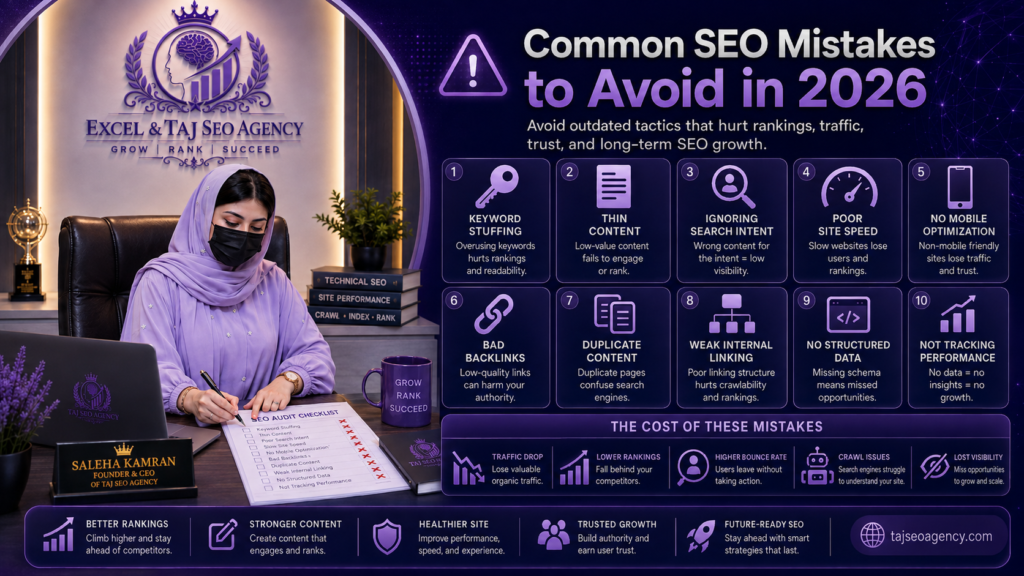
Many websites fail because they continue using strategies designed for an older version of Google.
Common SEO mistakes include publishing large quantities of thin AI-generated articles, writing primarily for keywords instead of users, copying competitors without adding original value, ignoring technical issues, using poor internal linking, neglecting mobile visitors, purchasing low-quality backlinks, and changing article dates without actually improving the content.
AI itself is not automatically a problem.
Google allows generative AI to support content production, but it warns that generating many pages without adding meaningful user value may violate its scaled content abuse policies.
AI tools can support research, organization, editing, brainstorming, and production.
The final content, however, should still provide originality, usefulness, accuracy, expertise, and human editorial judgment.
FAQs About SEO in 2026
Is SEO still worth it in 2026?
Yes. Search behavior is evolving, but businesses still need to be visible when people research products, services, companies, and problems.
Modern SEO can create visibility across traditional search results, AI features, local listings, images, videos, rich results, and other Google Search experiences.
Does AI-generated content rank on Google?
It can.
What matters is whether the final content is useful, original, accurate, trustworthy, and compliant with Google’s policies. Using automation primarily to mass-produce low-value pages can violate Google’s spam policies.
How long does SEO take to work?
There is no universal timeline.
Results depend on factors such as competition, website history, technical condition, content quality, backlink profile, existing authority, indexing, target keywords, and the amount of meaningful optimization being completed.
SEO should generally be viewed as a long-term growth strategy rather than a guaranteed quick-ranking tactic.
What matters most for ranking higher on Google?
There is no single ranking factor that guarantees success.
Google uses many systems and signals. A strong approach combines useful content, clear search intent, sound technical SEO, strong page experience, credible authority, relevant links, and continuous improvement based on performance data.
Is keyword density still important for SEO?
Keywords still help search engines and users understand the subject of a page, but artificial repetition is unnecessary.
Use your primary keyword naturally while covering related questions, subtopics, entities, and terminology. The priority should always be clarity and usefulness rather than achieving an exact keyword percentage.
Conclusion
SEO in 2026 is not about finding a secret trick that forces Google to rank a webpage.
It is about creating the strongest possible answer and supporting it with a website that is easy to crawl, technically healthy, fast to use, trustworthy, well connected, and genuinely valuable.
Search will continue to evolve through artificial intelligence, richer search results, local discovery, visual search, and new ways of accessing information. The fundamentals, however, remain surprisingly consistent: understand your audience, solve real problems, demonstrate expertise, make your pages technically accessible, and earn authority instead of trying to manufacture it.
For Taj SEO Agency, every article, service page, technical improvement, backlink, and internal link should work as part of one connected organic growth strategy.
When SEO is built around users and measurable business goals instead of short-term ranking tricks, higher Google rankings become the result of a stronger online presence—not the only definition of success.