
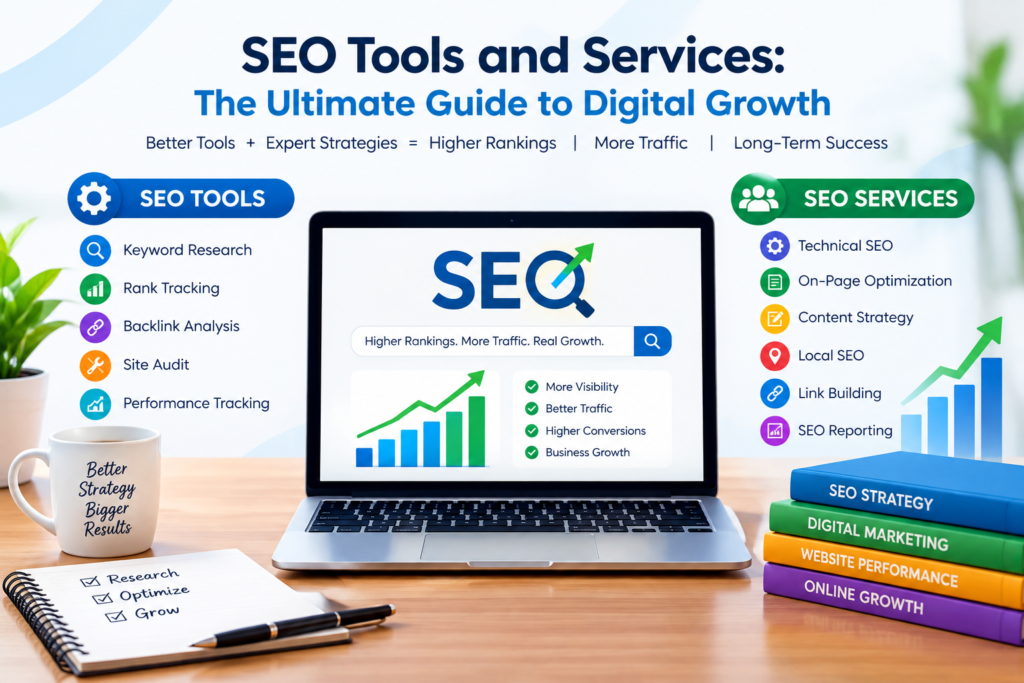
In today’s competitive digital landscape, having a website is not enough. Businesses need strong search visibility, useful content, technical performance, and a clear strategy to attract the right audience. This is where SEO tools and services become essential.
SEO tools help businesses discover keywords, analyze competitors, monitor rankings, identify technical issues, and measure website performance. SEO services, on the other hand, turn these insights into practical strategies that improve organic visibility and support long-term digital growth.
Whether you run a small business, eCommerce store, blog, startup, or established company, the right combination of tools and professional SEO support can make your online marketing more organized and effective.
Using the right SEO Tools and Services can make digital marketing more organized and measurable.
What Are SEO Tools and Services?
SEO Tools and Services are two connected parts of search engine optimization.
SEO tools are software platforms that provide data and insights about websites and search engines. They can help with keyword research, backlink analysis, site audits, content optimization, competitor research, and performance tracking.
SEO services involve professional activities performed to improve a website’s organic search visibility. These services may include technical SEO, on-page optimization, content strategy, local SEO, link building, and SEO reporting.
When used together, SEO tools and professional services can help businesses make better decisions based on measurable information rather than assumptions.
Why Are SEO Tools Important for Digital Growth?
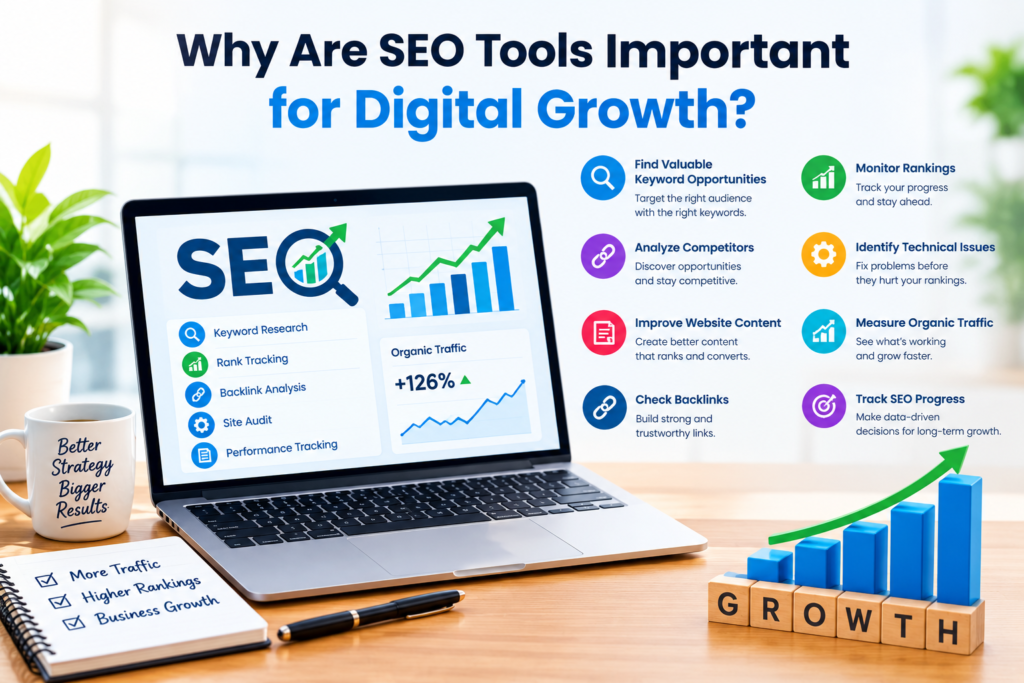
SEO Tools and Services help businesses organize their SEO research, optimization, and performance tracking.
Search engines evaluate many factors when determining which pages should appear in search results. Manually analyzing all these factors can take considerable time.
SEO tools simplify the process by collecting and organizing useful information.
Some major benefits include:
- Finding valuable keyword opportunities
- Understanding search intent
- Monitoring keyword rankings
- Identifying technical problems
- Analyzing competitors
- Checking backlinks
- Improving website content
- Measuring organic traffic
- Tracking SEO progress
For example, a keyword research tool can show what people search for and how competitive particular terms are. A technical SEO tool can identify broken links, missing metadata, indexing problems, or slow pages.
This information allows website owners to prioritize improvements.
Types of SEO Tools You Should Know
There are many SEO platforms available, and each one serves a different purpose. You do not necessarily need every tool. The best choice depends on your website, goals, budget, and SEO strategy.Different SEO Tools and Services can support keyword research, technical optimization, content planning, and performance tracking.
Keyword Research Tools
Keyword research tools help identify search terms that potential customers use.
They can provide information such as:
- Search volume
- Keyword difficulty
- Related keywords
- Search trends
- Long-tail keywords
- Search intent
- Competitor keyword data
Long-tail keywords can be especially useful for smaller websites because they often target more specific searches.
For example, instead of targeting a broad term like “SEO,” a business might target “SEO services for small businesses.” The second phrase has a more specific intent.
Technical SEO Tools
Technical SEO tools help identify problems that can affect crawling, indexing, and website performance.
Common technical checks include:
- Broken links
- Duplicate content
- Missing title tags
- Missing meta descriptions
- Crawl errors
- XML sitemap issues
- Robots.txt problems
- Mobile usability
- Page speed
- Redirect problems
A regular SEO audit can help website owners discover issues before they become larger problems.
On-Page SEO Tools
On-page SEO tools focus on individual pages and their content.
They can help analyze:
- Title tags
- Meta descriptions
- Headings
- Keyword usage
- Internal links
- Content structure
- Image optimization
- Readability
These tools can provide recommendations, but they should not replace human judgment. Content still needs to be useful, accurate, natural, and written for readers.
Backlink Analysis Tools
Backlinks remain an important part of SEO analysis. Backlink tools help website owners understand which websites link to their pages.
They can reveal:
- Referring domains
- Backlink sources
- Anchor text
- Lost backlinks
- New backlinks
- Competitor backlink opportunities
The goal should not simply be to collect as many links as possible. Relevant and trustworthy links are generally more useful than large numbers of low-quality links.
Rank Tracking Tools
Rank tracking platforms monitor how a website performs for selected keywords over time.
This can help businesses understand whether their SEO strategy is producing changes in search visibility.
However, rankings should not be the only performance metric. Organic traffic, conversions, leads, engagement, and revenue can provide additional context.
What Are SEO Services?
SEO services are professional strategies and activities designed to improve a website’s organic search performance.
A comprehensive SEO campaign may include several areas.
Keyword Research and Strategy
A successful campaign begins with understanding the audience and its search behavior.
SEO professionals research relevant terms and organize them according to search intent. Keywords can then be mapped to existing pages or used to create new content.
The strategy should consider informational, commercial, navigational, and transactional searches.
On-Page SEO Services
On-page SEO focuses on optimizing the content and structure of individual web pages.
Common activities include:
- Optimizing page titles
- Improving headings
- Creating useful meta descriptions
- Improving internal linking
- Optimizing images
- Refining content structure
- Matching content with search intent
The objective is to make pages easier for both users and search engines to understand.
Technical SEO Services
Technical SEO focuses on the infrastructure and accessibility of a website.
An SEO professional may examine crawling, indexing, website architecture, mobile performance, page speed, structured data, redirects, and other technical elements.
A technically strong website gives search engines a clearer path to discover and understand its content.
Local SEO Services
Local SEO is particularly important for businesses that serve specific geographic areas.
A local SEO strategy can include optimizing business information, improving local landing pages, managing citations, and developing relevant content.
For example, a local service company may want to appear when customers search for services combined with a city or neighborhood.
Content SEO Services
Content is a major part of modern search optimization.
Professional content SEO can involve:
- Identifying relevant topics
- Researching search intent
- Creating content outlines
- Optimizing existing pages
- Building topic coverage
- Improving internal links
- Updating outdated information
High-quality content should answer real questions and provide information that users can actually use.
SEO Tools vs. SEO Services
SEO Tools and Services work together by combining useful data with practical optimization strategies.
SEO tools and SEO services are related, but they are not the same.
| SEO Tools | SEO Services |
|---|---|
| Provide data and insights | Turn data into strategies |
| Help identify problems | Help solve problems |
| Can automate analysis | Require planning and execution |
| Useful for monitoring | Useful for complete campaigns |
| Usually software-based | Usually provided by professionals |
A business can use SEO tools independently, but interpreting the data correctly can require experience.
For example, a tool may report that a page has a technical issue. An SEO professional must determine how important that issue is and whether fixing it should be prioritized.
How to Choose the Right SEO Tools
There is no single tool that is perfect for every website.Businesses can use SEO Tools and Services to monitor their progress and identify areas that need improvement.
Before choosing an SEO platform, consider:
Your SEO Goals
First determine what you want to accomplish. Are you focused on keyword research, technical SEO, backlinks, local search, content, or overall performance?
Your goals should determine your tool selection.
Your Budget
SEO tools range from free platforms to expensive enterprise solutions. Small businesses should focus on tools that provide useful data without unnecessary features.
Website Size
A small business website may not need the same level of monitoring as a large eCommerce website with thousands of pages.
Reporting Features
If you manage SEO for clients, reporting is especially important. Look for tools that make it easy to track changes and communicate results.
Data Quality
Different tools can provide different estimates. SEO data should be treated as directional information rather than absolute truth.
How Professional SEO Services Support Business Growth
A combination of SEO Tools and Services can help businesses monitor performance and improve their digital marketing strategy.
SEO is not simply about getting visitors. The objective is to attract relevant users who may become customers, subscribers, leads, or returning visitors.
Professional SEO services can support this process by connecting technical improvements, content, keywords, and business goals.
A structured SEO campaign often follows this process:
Website Audit → Keyword Research → Strategy → Optimization → Content → Authority Building → Monitoring → Improvement
This ongoing process is important because search results and user behavior can change over time.
Businesses looking for professional support can explore SEO services from Taj SEO Agency to develop a strategy based on their website and digital marketing goals.
How to Create an Effective SEO Strategy
Businesses can use SEO Tools and Services to monitor their progress and identify areas that need improvement.
Step 1: Audit the Website
Start by checking technical performance, existing content, indexing, backlinks, and overall site structure.
Step 2: Research Keywords
Identify relevant keywords based on search intent, competition, and business relevance.
Step 3: Analyze Competitors
Study competing websites to understand their content structure, keyword targeting, backlinks, and areas where your website can provide additional value.
Step 4: Optimize Existing Pages
Improve important pages before creating hundreds of new ones. Update titles, headings, content, internal links, images, and other relevant elements.
Step 5: Build Useful Content
Create content that answers specific questions and covers topics comprehensively.
Step 6: Monitor Results
Use SEO analytics and ranking tools to monitor organic traffic, keyword visibility, conversions, and other meaningful metrics.
Step 7: Continue Improving
SEO is an ongoing process. Review results regularly and adjust the strategy based on performance and changing search behavior.
Common SEO Mistakes to Avoid
Even with powerful SEO tools, mistakes can reduce the effectiveness of a campaign.
Focusing Only on Keywords
Using a keyword repeatedly does not automatically make content better. Search engines increasingly focus on usefulness, relevance, and context.
Ignoring Technical SEO
Excellent content can struggle if search engines cannot properly crawl or index the website.
Buying Low-Quality Backlinks
Large numbers of irrelevant or manipulative links can create SEO risks. Link-building strategies should focus on relevance and genuine value.
Publishing Without Search Intent
A page may target the right keyword but still fail to satisfy what users actually want.
Ignoring Existing Content
Updating valuable older content can sometimes be more practical than continuously producing new articles.
Measuring Only Rankings
Rankings are useful, but they do not tell the complete story. Businesses should also monitor organic traffic, leads, conversions, and revenue.
SEO Metrics You Should Monitor
SEO performance should be measured using several indicators.
Important metrics include:
- Organic traffic
- Keyword visibility
- Click-through rate
- Conversions
- Leads
- Revenue from organic search
- Indexed pages
- Backlink growth
- Engagement metrics
- Page performance
The most important metrics depend on the business model and objectives.
For example, an online store may focus heavily on organic revenue and product-page performance, while a local service company may prioritize qualified leads and local visibility.
Future of SEO Tools and Services
The future of SEO Tools and Services will continue to involve automation, data analysis, and human expertise.As search technology evolves, SEO Tools and Services will continue to support data-driven SEO strategies.
The SEO industry continues to evolve as search technology, artificial intelligence, user behavior, and digital platforms change.
Modern SEO tools are increasingly capable of processing large amounts of data and identifying patterns. AI can also assist with research, content planning, technical analysis, and workflow automation.
However, technology does not eliminate the need for strategy. As search technology evolves, SEO Tools and Services will continue to support data-driven SEO strategies.
Businesses still need people who can understand their audience, evaluate information, make strategic decisions, and create genuinely useful experiences.
The future of SEO is likely to involve a stronger combination of automation, data analysis, quality content, technical optimization, and human expertise.
Conclusion
Choosing the right SEO Tools and Services can make SEO management more structured and measurable.
SEO Tools and Services provide businesses with the resources and expertise needed to improve their online visibility and build sustainable digital growth. Tools can reveal keywords, technical problems, competitor information, backlinks, and performance trends, while professional SEO services help turn those insights into an organized strategy.
The most effective approach is not to use every available tool or chase every ranking opportunity. Instead, businesses should focus on relevant keywords, helpful content, strong technical foundations, quality user experiences, and measurable business outcomes.
With consistent analysis and optimization, SEO can become a long-term digital marketing channel that supports visibility, traffic, leads, and business growth.
Frequently Asked Questions
1. What are SEO Tools and Services?
SEO Tools and Services include software and professional strategies used to improve a website’s search visibility. Tools provide data, while services help plan and implement SEO improvements.
2. Which SEO tools are best for beginners?
Beginners can start with tools that provide keyword research, website performance, search analytics, and basic technical SEO information. The best choice depends on the website’s goals and budget.
3. Why are SEO services important for a business?
SEO services help businesses develop and implement strategies for technical optimization, content, keywords, local search, and organic visibility. Professional support can also make SEO work more organized.
4. How long does SEO take to show results?
SEO results vary depending on factors such as website authority, competition, technical condition, content quality, and the strategy being implemented. SEO generally requires consistent work rather than instant results.
5. Can I use SEO tools without hiring an SEO agency?
Yes. Website owners can use many SEO tools independently. However, interpreting complex data and developing an effective long-term strategy may require SEO knowledge and experience.