
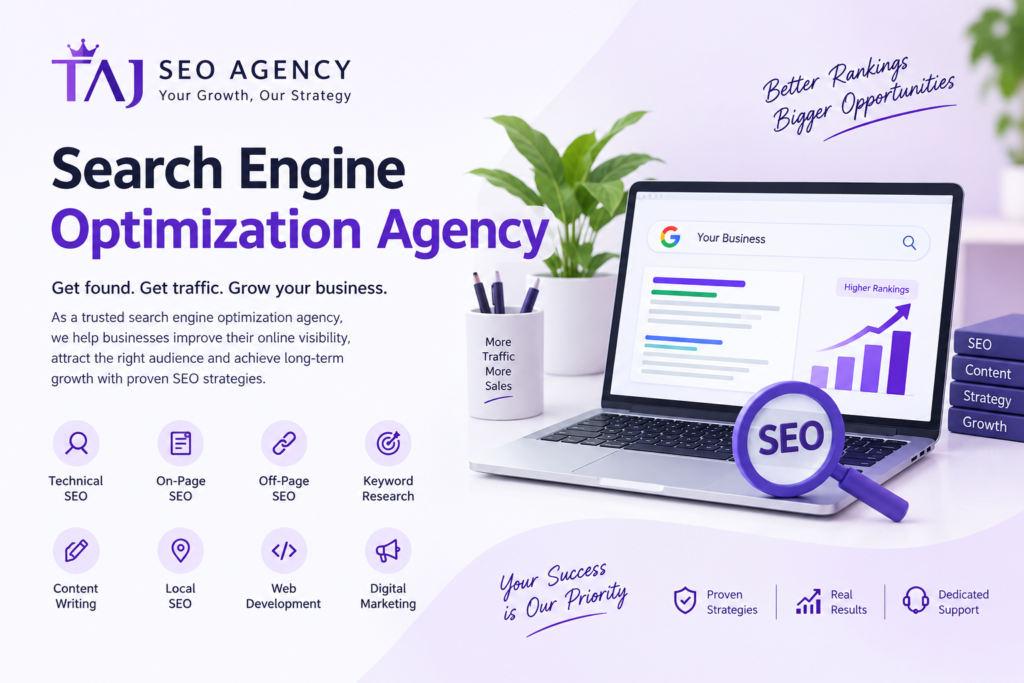
Introduction
In today’s digital world, having a website is only the first step toward building a successful online business. With millions of websites competing for attention, businesses need an effective strategy to reach their target audience, attract relevant visitors, and turn those visitors into customers. This is where a professional search engine optimization agency can make a meaningful difference.
Search engine optimization, commonly known as SEO, helps websites improve their visibility in search engine results. When people search for products, services, or solutions related to a business, SEO helps search engines understand the website and determine which pages may be useful to those users. A well-planned strategy can help businesses increase organic traffic, build credibility, and generate long-term growth without relying entirely on paid advertising.
However, SEO involves much more than adding keywords to website content. It requires technical improvements, relevant content, keyword research, competitor analysis, link building, and continuous performance monitoring. Every website has different challenges, so an effective strategy should be based on its current condition, industry, competition, and business objectives.
Businesses looking for professional support can explore Taj SEO Agency to learn more about SEO and web development services designed to improve online visibility and support business growth.
What Is a Search Engine Optimization Agency?
A search engine optimization agency is a professional service provider that helps businesses improve their websites’ visibility in organic search results. Its primary objective is to make a website easier for search engines to discover, crawl, understand, and present to relevant users.
SEO agencies work with different types of businesses, including e-commerce stores, service providers, local companies, startups, and established organizations. Their responsibilities depend on the client’s requirements and may include improving website structure, optimizing existing pages, creating helpful content, building relevant backlinks, and identifying technical issues.
For example, a company offering web development services may want to appear when potential customers search for a web developer in their country. An SEO agency can research relevant search terms, optimize the company’s service pages, improve website performance, and develop a content strategy that addresses customer needs.
The goal is not simply to attract more visitors. It is to attract the right visitors who are genuinely interested in the company’s products or services.
A reliable agency also understands that search rankings are not guaranteed. Search engines regularly update their systems, and competitors continue improving their websites. Sustainable SEO therefore requires research, consistent implementation, and ongoing evaluation.
How Does Search Engine Optimization Work?
Search engines use automated systems to discover and evaluate web pages before displaying relevant results to users. A professional search engine optimization agency helps businesses improve their website’s accessibility, content, and overall search visibility.
A search engine optimization agency analyzes how search engines crawl, understand, and index website pages. Through effective SEO strategies, a search engine optimization agency can identify technical issues, optimize relevant content, and improve website structure.
By working with a reliable search engine optimization agency, businesses can strengthen their online presence, attract relevant visitors, and work toward sustainable organic growth.
Crawling and Indexing
Crawling occurs when search engine bots discover and access website pages. They may find these pages through internal links, external links, and submitted XML sitemaps.
Indexing involves processing information about a page and potentially storing it in a search engine’s index. A page that cannot be crawled properly, is blocked from indexing, or contains conflicting technical signals may struggle to appear in search results.
An SEO specialist checks issues such as robots.txt directives, noindex tags, canonical URLs, redirects, sitemap configuration, and internal linking. These checks help identify obstacles that could prevent important pages from appearing in search results.
Submitting a sitemap does not guarantee indexing, but it can help search engines discover important URLs.
Understanding Search Intent
Search intent describes the reason behind a user’s search. Someone searching for “what is technical SEO” probably wants an explanation, while someone searching for “SEO agency for an e-commerce store” may be comparing service providers.
Understanding this difference is essential when creating content and optimizing service pages. A page should address the information users expect to find rather than simply repeat a target keyword.
When the content matches the user’s needs, visitors are more likely to find it useful and take an appropriate next step.
Ranking Relevant Pages
After discovering and processing pages, search engines use many signals to determine which results are most relevant to a particular query. A professional search engine optimization agency considers factors such as content relevance, usability, page experience, links, and the overall quality and usefulness of the information.
No single optimization technique guarantees a top position. A reliable search engine optimization agency combines multiple SEO improvements while prioritizing the needs of real users.
By analyzing these ranking factors, a search engine optimization agency can identify opportunities to improve website visibility and develop an effective strategy. Working with an experienced search engine optimization agency helps businesses focus on sustainable organic growth rather than relying on a single optimization technique.
Essential Services Offered by an SEO Agency
A professional SEO campaign usually includes several connected activities. The exact services depend on the website’s current performance, the client’s budget, and the competition in the target market.
Technical SEO
Technical SEO is an essential service offered by a professional search engine optimization agency. It focuses on the technical elements that help search engines access, interpret, and index a website effectively.
A reliable search engine optimization agency reviews website architecture, checks broken links, fixes redirect problems, evaluates canonical tags, improves mobile usability, and assesses page speed. Specialists may also review structured data, XML sitemaps, crawl errors, and indexing reports.
For example, an online store may have hundreds of product pages that are difficult for search engines to discover because of poor internal linking. A search engine optimization agency can identify these issues and improve the site’s structure, helping search engines find important pages more efficiently.
Technical SEO also supports a better user experience. A website that loads reliably and works well on mobile devices makes it easier for customers to explore products and services. A professional search engine optimization agency can identify performance issues and recommend practical improvements.
By addressing technical problems, a search engine optimization agency helps businesses build a stronger website foundation, improve crawlability, and support long-term organic growth.
On-Page SEO
On-page SEO improves the content and HTML elements of individual website pages. The objective is to make each page relevant to its intended search queries while providing a clear and useful experience for visitors.
This process can involve optimizing title tags, meta descriptions, headings, URLs, image alt text, internal links, and page content. It also includes ensuring that each page has a clear purpose and answers the questions users are likely to ask.
For example, a service page targeting customers interested in SEO services should explain what the service includes, who it is suitable for, how the process works, and what clients can reasonably expect.
A good on-page SEO strategy uses keywords naturally. Repeating the same phrase excessively can make content difficult to read and does not guarantee better rankings.
Off-Page SEO and Link Building
Off-page SEO includes activities outside a website that can contribute to its reputation and visibility. One important aspect is earning backlinks from other websites.
A backlink is a link from one website to another. Relevant, editorially earned links can help search engines discover content and provide useful context about a website’s reputation. However, not every backlink has equal value.
An effective link-building strategy focuses on relevance, editorial standards, genuine audiences, and the quality of the linking website. Guest posting can be useful when it involves publishing original, valuable content on relevant websites and earning appropriate links.
Businesses should be cautious of services that promise hundreds of backlinks within a short period without explaining their quality. Manipulative link schemes and large-scale low-quality link creation can create search risks.
A trustworthy agency prioritizes sustainable practices and evaluates links based on their relevance and potential value rather than relying exclusively on domain authority metrics.
Keyword Research
Keyword research identifies the words and phrases people use when searching for information, products, and services. It helps businesses understand their audiences and determine which topics deserve attention.
A useful research process examines search intent, keyword relevance, competition, business value, and the type of content currently appearing in search results.
For instance, a local service provider may target location-specific queries, while an international software company may focus on industry-related terms that attract decision-makers.
Keyword research should also identify related questions and supporting topics. This helps businesses build comprehensive content that answers customer concerns throughout the buying journey.
Content Writing and Content Optimization
High-quality content is central to effective SEO because it helps users understand a topic and make informed decisions.
An SEO agency may develop service pages, blog articles, product descriptions, location pages, and educational resources. Existing content can also be reviewed for outdated information, missing details, unclear headings, or poor search intent alignment.
Useful content should demonstrate subject knowledge, provide accurate explanations, and answer real questions. It should not exist solely to insert keywords into a page.
Content optimization also involves maintaining a logical heading structure, adding relevant internal links, using descriptive image text, and ensuring that important information is easy to find.
AI tools may support research and drafting, but the final content still needs human review for accuracy, originality, clarity, and practical value.
Local SEO and Google Business Profile Optimization
Local SEO helps businesses reach customers searching for services in a specific geographical area. It is particularly useful for restaurants, clinics, repair services, agencies, shops, and other businesses serving local communities.
A local SEO campaign may include optimizing the Google Business Profile, maintaining accurate business information, improving location pages, managing customer reviews, and building relevant local citations.
Consistency matters. Business names, addresses, phone numbers, opening hours, and service information should be accurate wherever they appear.
Local visibility depends on several factors, including relevance, distance, and prominence. An agency can improve the information and website signals under a business’s control, but it cannot guarantee a particular map ranking.
Web Development and SEO Integration
Website development and SEO work best when they support the same business objectives. A website may have attractive visuals, but poor navigation, slow loading, confusing layouts, or technical problems can reduce its effectiveness.
An agency offering both web development and SEO can coordinate website structure, mobile responsiveness, page templates, internal links, and content requirements from the beginning.
This approach can be especially beneficial for new businesses launching their first website or established companies redesigning an existing one.
Before making major changes to a live website, the team should review existing URLs, traffic, backlinks, and indexed pages. Appropriate redirects and migration checks can help reduce the risk of losing valuable search visibility.
Benefits of Hiring a Professional SEO Agency
Increased Organic Visibility
An SEO campaign can help relevant pages become more competitive in search results. Better visibility allows potential customers to discover a business while actively looking for information or services.
Organic search can be particularly valuable when a company consistently attracts visitors who match its target audience.
More Relevant Website Traffic
High traffic numbers do not automatically translate into business growth. The quality of visitors is often more important than the total number.
An experienced agency focuses on queries that align with the company’s services, products, locations, and customer needs. This can help reduce irrelevant visits and attract people who are more likely to engage with the business.
Stronger Online Credibility
Customers often research a business before making a purchase or contacting a service provider. Helpful content, clear service information, a reliable website, and genuine reviews can strengthen trust.
Consistent SEO work can support this process by making useful information easier to find and improving the overall experience of visiting the website.
Long-Term Marketing Value
Paid advertising can generate visibility while a campaign is active, whereas organic search can continue bringing visitors to well-performing pages over time.
SEO still requires investment in content, maintenance, technical improvements, and link acquisition where appropriate. Rankings may fluctuate, and results are never permanent. Nevertheless, useful content and a technically sound website can become valuable long-term marketing assets.
Better Understanding of Customer Behavior
SEO reporting can reveal which search queries attract visitors, which pages generate engagement, and where users encounter problems.
This information can inform content planning, service development, website improvements, and conversion optimization. When SEO data is connected with business outcomes, companies can make better-informed marketing decisions.
How to Choose the Right Search Engine Optimization Agency
Selecting an agency requires more than comparing prices or accepting promises of quick rankings. Businesses should understand the proposed strategy, how progress will be measured, and what work will actually be delivered.
Review the Audit and Strategy
A professional agency should begin by understanding the website’s current condition. This usually involves reviewing technical health, content quality, search visibility, competitors, and the business’s objectives.
The resulting audit should identify specific issues and explain which improvements deserve priority. Instead of providing a generic list of recommendations, the agency should connect its proposed work to the website’s actual needs.
Ask About Reporting and Communication
Transparent reporting helps clients understand what has been completed and what remains to be done.
Reports may include organic clicks, impressions, click-through rate, average search position, indexed pages, relevant keyword performance, organic conversions, and technical improvements. Google Search Console and analytics platforms can provide useful evidence, although individual metrics must be interpreted in context.
A good agency explains both progress and challenges rather than presenting rankings without discussing their business impact.
Understand the Pricing Structure
SEO pricing varies according to website size, competition, service requirements, geographical targets, and the amount of work involved.
Some agencies charge a monthly retainer, while others offer fixed-price audits, project-based optimization, or clearly defined consulting services.
Before agreeing to a package, clients should understand the deliverables, reporting schedule, content requirements, backlink costs, software expenses, and any additional charges. Extremely low prices may indicate limited work, while high prices alone do not prove quality.
Avoid Guaranteed Ranking Claims
No agency can control every factor affecting search results. Search engines change their systems, competitors improve their websites, and some queries are considerably more competitive than others.
Be cautious of anyone promising a guaranteed first position within a fixed number of days. A credible provider will explain the strategy, identify measurable objectives, and set realistic expectations based on the available evidence.
How Taj SEO Agency Can Support Business Growth
Businesses seeking assistance with organic visibility, website optimization, and digital growth can explore Taj SEO Agency.
The agency’s service areas include search engine optimization, technical SEO, on-page SEO, off-page SEO, guest posting, backlink building, content writing, local SEO, and web development.
These services address different aspects of a website’s performance. Technical improvements can help search engines access important pages, on-page optimization can make content more relevant, and content development can address customer questions. Relevant link-building activities may also support a website’s wider authority and visibility.
For businesses interested in working with an SEO agency, the starting point should be a clear understanding of their website’s current condition and their commercial objectives.
A structured engagement typically begins with a website audit and a discussion of target markets, competitors, existing traffic, and conversion goals. Based on those findings, the team can develop a prioritized plan, implement agreed improvements, and monitor progress.
Businesses should evaluate any agency using clear deliverables, transparent communication, and measurable performance data. This makes it easier to understand how the work supports the company’s broader growth strategy.
How Long Does SEO Take to Produce Results?
SEO timelines depend on the website’s history, technical condition, competition, content quality, and the resources available for implementation.
Some improvements, such as fixing an incorrect noindex directive or repairing broken internal links, may resolve a specific technical problem relatively quickly. However, the effect on search traffic and rankings can take longer to become visible.
For a newer website operating in a competitive market, meaningful growth may require several months of consistent work. Established websites with strong foundations may see progress sooner for certain queries, while highly competitive industries can require a longer-term strategy.
Businesses should evaluate progress using several indicators rather than expecting immediate ranking changes. Search impressions, organic clicks, relevant keyword visibility, qualified leads, and conversions can provide a more complete picture.
The most useful question is not simply how quickly a website can rank, but whether the SEO strategy is helping the business attract relevant visitors and achieve its objectives over time.
Common SEO Mistakes Businesses Should Avoid
One common mistake is creating content without understanding search intent. A page may include the correct keywords but still fail to answer the questions users want resolved.
Another problem is neglecting technical SEO. Broken links, incorrect canonical tags, accidental noindex directives, and poor site architecture can interfere with search visibility.
Some businesses also focus too heavily on backlink quantities. A large backlink profile does not automatically indicate quality, and manipulative link-building practices may expose a website to search engine spam policies.
Ignoring mobile users is another avoidable issue. A website should be easy to navigate, readable, and functional across different screen sizes.
Finally, businesses sometimes stop improving their websites once rankings increase. Search visibility requires ongoing attention because content becomes outdated, competitors publish new material, and user expectations change.
Avoiding these mistakes starts with a clear strategy, regular monitoring, and a willingness to improve the website based on reliable data.
How to Measure the Success of an SEO Campaign
An effective SEO campaign should be evaluated against specific objectives established at the beginning of the engagement.
Google Search Console can help businesses understand how their pages perform in Google Search. It provides information about impressions, clicks, click-through rate, average position, indexing, and certain technical issues.
Analytics tools can provide additional insight into user behavior, landing-page performance, and conversions. For a service business, meaningful outcomes may include qualified inquiries, phone calls, contact-form submissions, and booked consultations. For an online store, purchases and revenue may be more important.
Reporting should distinguish between activity and outcomes. Publishing ten articles or acquiring several backlinks describes work completed, but it does not necessarily demonstrate business success.
A useful report explains what changed, what the data indicates, which objectives have been achieved, and what actions should follow. It should also acknowledge limitations, such as seasonal changes, tracking issues, and search algorithm updates.
When clients and agencies agree on clear performance indicators, SEO becomes easier to evaluate as a business investment rather than simply a collection of technical tasks.
Conclusion
A professional search engine optimization agency can help businesses improve organic visibility, attract relevant visitors, strengthen their online presence, and build a more sustainable digital marketing strategy. Successful SEO combines technical improvements, keyword research, helpful content, on-page optimization, relevant backlinks, and ongoing performance analysis.
Choosing the right agency requires careful evaluation of its strategy, communication, reporting practices, pricing, and ability to explain realistic expectations. Businesses should prioritize useful work and measurable outcomes instead of relying on promises of instant rankings.
For organizations looking to improve their websites through SEO and web development, Taj SEO Agency is a resource worth exploring. A well-planned strategy, supported by consistent implementation and evidence-based decisions, can help a business build stronger search visibility and work toward its long-term growth goals.
Frequently Asked Questions
1. What does a search engine optimization agency do?
A search engine optimization agency helps businesses improve their organic search visibility through technical SEO, keyword research, content optimization, link building, and performance monitoring. Its work aims to make websites more accessible to search engines and more useful to potential customers.
2. How much does it cost to hire an SEO agency?
The cost depends on the website’s size, industry competition, target market, and required services. Some agencies charge monthly retainers, while others offer fixed-price audits or project-based services. Businesses should compare the actual deliverables, reporting, and expected scope of work before choosing a package.
3. How long does it take to see SEO results?
SEO results vary depending on competition, website condition, content quality, and implementation. Some technical fixes can resolve problems relatively quickly, but meaningful improvements in organic visibility and conversions often require several months of consistent work. No specific ranking timeline can be guaranteed.
4. What is the difference between on-page SEO and technical SEO?
On-page SEO focuses on individual page elements, including titles, headings, content, keywords, images, and internal links. Technical SEO focuses on website accessibility, crawling, indexing, site structure, performance, and other technical factors. Both are important for a comprehensive SEO strategy.
5. How can I choose the best SEO agency for my business?
Choose an agency that understands your business goals, provides a clear website audit, explains its strategy, and offers transparent reporting. Review its relevant experience, pricing, deliverables, and communication process. Avoid providers that guarantee first-page rankings or promise unrealistic results without explaining their methods.