
Introduction
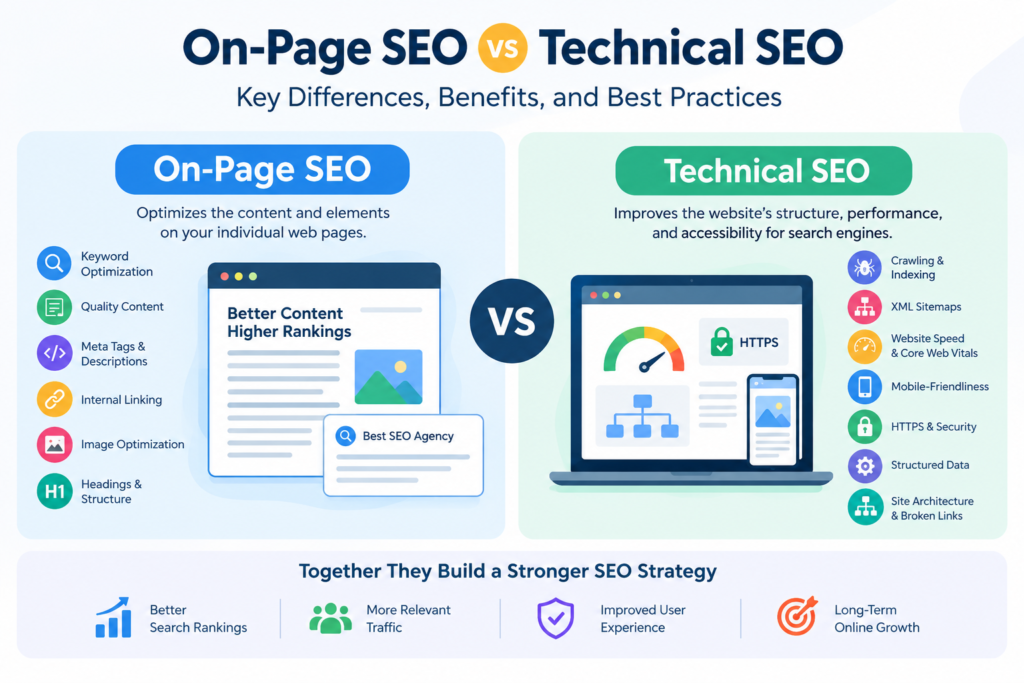
Search engine optimization (SEO) involves several strategies that help websites become more visible in search engine results, attract relevant visitors, and provide a better user experience. Two important parts of this process are on-page SEO and technical SEO. Understanding on-page SEO vs technical SEO helps website owners identify the differences between content optimization and website performance improvements. Although both aim to improve a website’s search performance, they focus on different aspects of optimization.
Understanding on-page SEO vs technical SEO is essential for website owners, bloggers, digital marketers, and businesses that want to strengthen their online presence. On-page SEO focuses on the content and elements users can see on individual web pages, while technical SEO focuses on the website’s underlying structure, accessibility, performance, and ability to be crawled and indexed by search engines.
For example, a business website might publish high-quality articles targeting relevant keywords but still struggle to gain visibility because search engines cannot properly access or index its pages. Similarly, a technically sound website may receive limited organic traffic if its content does not address users’ questions or match their search intent. Understanding on-page SEO vs technical SEO helps businesses identify whether their challenges relate to content optimization or technical performance.
Both areas work together to support a successful SEO strategy. Comparing on-page SEO vs technical SEO helps businesses identify website problems, prioritize improvements, and make informed decisions about optimization. By combining both approaches, website owners can create a better user experience and build a stronger foundation for long-term organic search visibility.
At Taj SEO Agency, businesses can explore SEO strategies designed to improve website quality, search visibility, and organic growth. Learning how on-page SEO and technical SEO complement each other is a useful first step toward building a stronger online presence.
What Is On-Page SEO?
On-page SEO is the process of optimizing individual web pages to help search engines understand their content and help visitors find the information they need. It involves improving written content, HTML elements, internal links, images, headings, and other page-level factors. Understanding on-page SEO vs technical SEO helps website owners identify the right optimization strategies for better search performance.
The primary purpose of on-page SEO is to make a page relevant to a particular topic and useful for its intended audience. When a page clearly answers a searcher’s question, uses descriptive headings, and provides a logical reading experience, it becomes easier for both people and search engines to understand its purpose. Comparing on-page SEO vs technical SEO also helps businesses understand how content quality and website functionality work together.
For instance, a website offering digital marketing services might publish an article about choosing an SEO agency. Effective on-page optimization would involve creating a descriptive title, using the main keyword naturally, explaining related concepts, adding useful internal links, and writing a meta description that accurately summarizes the page. When evaluating on-page SEO vs technical SEO, businesses should consider how these content improvements complement the technical health of their websites.
On-page SEO is not simply about placing keywords throughout an article. It requires a combination of relevance, clarity, useful information, and a well-organized page structure. The goal is to satisfy the reader’s needs while making the subject of the page clear to search engines. A clear understanding of on-page SEO vs technical SEO allows website owners to build a more effective and balanced SEO strategy.
Key Elements of On-Page SEO
Keyword Research and Search Intent
Keyword research helps identify the words and phrases people use when searching for information, products, or services. It provides insight into what potential visitors want to learn and how a website can address their needs.
For effective on-page SEO, selecting a relevant primary keyword is only the beginning. Content should also cover related concepts and answer the questions users are likely to have. Search intent is equally important because the same keyword can have different meanings depending on the user’s goal.
For example, someone searching for “on-page SEO vs technical SEO” probably wants to understand the differences between the two methods, when each is needed, and how they work together. An article that directly answers these questions is more useful than a page that repeatedly mentions the keyword without explaining it.
Title Tags and Meta Descriptions
A title tag communicates the subject of a web page and can appear as the clickable headline in search results. It should accurately describe the page, remain concise, and include the primary keyword where appropriate.
A meta description provides a short summary of the page. Although it is not a direct Google ranking factor, a relevant description may help searchers understand what they will find and encourage them to visit the website.
For an article comparing on-page and technical SEO, a suitable title could be “On-Page SEO vs Technical SEO: Key Differences Explained.” A corresponding meta description could explain that the article compares both approaches, highlights their benefits, and describes when businesses should use them.
Heading Structure and Content Quality
Headings organize information into clear sections, making an article easier to scan and understand. A descriptive H1 heading establishes the main topic, while H2 and H3 headings divide the content into logical sections and supporting subjects.
High-quality content should provide accurate information, explain unfamiliar concepts, and answer relevant questions. It should avoid unnecessary repetition and offer practical examples that help readers apply what they learn.
Content length alone does not determine search performance. A longer article is valuable when its additional detail serves the reader, but adding unnecessary paragraphs simply to reach a word count does not automatically improve SEO.
Internal Linking
Internal links connect one page of a website to another page on the same domain. They help visitors discover related information and provide search engines with additional context about the site’s structure.
For example, an article about on-page SEO could link naturally to relevant pages covering keyword research, content optimization, technical website audits, and SEO services.
Descriptive anchor text makes these links more useful because readers can understand what to expect before clicking. Internal linking also helps businesses guide visitors from informational content toward relevant service pages without making the experience feel overly promotional.
Image Optimization
Images can make content easier to understand, but they should be relevant to the page and appropriately optimized.
Useful image optimization practices include descriptive file names, meaningful alternative text, suitable image dimensions, and efficient file formats. Alternative text should describe the image’s purpose or meaningful visual information rather than repeat keywords unnecessarily.
Optimized images can improve accessibility and reduce unnecessary page weight, supporting the broader website experience.
URL Structure and User Experience
Clear URLs help visitors and search engines understand what a page covers. A concise URL such as /on-page-seo-vs-technical-seo/ is generally easier to interpret than a long URL containing irrelevant parameters.
A well-organized page should also be easy to navigate, readable on mobile devices, and designed around the visitor’s needs. Good on-page SEO considers how people interact with content rather than treating optimization as a purely technical exercise.
What Is Technical SEO?
Technical SEO focuses on improving the infrastructure of a website so search engines can discover, crawl, render, and index its content effectively. It also addresses technical issues that may affect website performance, accessibility, security, and user experience.
Unlike on-page SEO, which primarily improves individual pages and their content, technical SEO examines how the website functions as a whole and how its pages are delivered to users and search engines.
For example, a business may have excellent service pages and informative blog posts, but an incorrect noindex directive could prevent important pages from appearing in search results. A broken internal linking structure might make some pages difficult to discover, while a slow website could create a frustrating experience for visitors.
Technical SEO helps identify and resolve these issues. However, technical perfection alone does not guarantee rankings. Search engines also consider relevance, content quality, competition, and many other signals when determining which results to show.
Key Elements of Technical SEO
Website Crawling and Indexing
Crawling occurs when search engine crawlers access URLs and examine their content. Indexing is the process through which search engines analyze and potentially store eligible pages for use in search results.
A technically healthy website should allow search engines to access its important content without unnecessary obstacles.
The robots.txt file can control crawler access to specified URL paths, while robots meta tags and X-Robots-Tag HTTP headers can provide indexing instructions. These mechanisms serve different purposes. Blocking a URL from crawling does not necessarily prevent that URL from being indexed, especially if search engines discover it through external links.
Canonical tags can help indicate a preferred version among duplicate or similar pages, but search engines treat canonicalization as a signal rather than an absolute command.
Regular technical audits can uncover accidental indexing restrictions, duplicate URL problems, crawl errors, and pages that are not being discovered as intended.
XML Sitemaps
An XML sitemap lists URLs that a website owner considers important for search engines to discover. It can be particularly helpful for large websites, newly published pages, and websites with complex structures.
A sitemap should generally include canonical URLs that are intended to be indexed. It should not be treated as a guarantee that every listed page will be crawled or indexed.
Submitting a sitemap through Google Search Console allows website owners to monitor its processing status and identify certain errors. Internal links remain important because they help search engines understand relationships between pages and discover content naturally.
Website Speed and Core Web Vitals
Website performance affects how quickly visitors can access and interact with content. Slow loading, delayed interactions, and unexpected layout shifts can make a website difficult to use.
Google’s Core Web Vitals measure aspects of real-world user experience through three principal metrics.
Largest Contentful Paint (LCP) measures how quickly the main content becomes visible. Interaction to Next Paint (INP) measures responsiveness to user interactions. Cumulative Layout Shift (CLS) measures unexpected visual movement during page loading.
Improving these metrics may involve optimizing images, reducing unnecessary JavaScript, improving server response times, using browser caching, and reviewing third-party scripts.
Core Web Vitals are part of Google’s page experience considerations, but achieving good scores does not guarantee top rankings. Relevant content and overall search quality remain important.
Mobile-Friendly Website Design
A website should work properly on smartphones, tablets, and desktop computers. Text should be readable, navigation should be accessible, and important content should remain available across supported screen sizes.
Google primarily uses the mobile version of website content for indexing. Consequently, a website that hides important content or serves substantially different information on mobile devices may create SEO challenges.
Responsive design is a common approach because it allows a website’s layout to adapt to different screen sizes. Testing pages on mobile devices can reveal usability problems that might not be apparent when viewing the desktop version alone.
HTTPS and Website Security
HTTPS encrypts information exchanged between a browser and a website, helping protect data from interception or alteration during transmission.
A valid HTTPS configuration is an important website security practice and a lightweight Google ranking signal. Website owners should ensure their pages use secure URLs, maintain valid certificates, and avoid mixed-content issues in which insecure resources load within secure pages.
HTTP-to-HTTPS redirects should also be configured correctly to help visitors and search engines reach the preferred version of the website.
Structured Data
Structured data is a standardized way of describing information on a web page so search engines can better understand specific entities and content types.
For example, suitable structured data may describe an organization, a product, an article, or a local business. Depending on the content and eligibility requirements, it may help a page qualify for enhanced search result presentations.
Structured data must accurately reflect the visible content and follow the relevant search engine guidelines. Adding markup does not guarantee a rich result or a ranking improvement.
Website Architecture and Broken Links
Website architecture describes how pages are organized and connected. A logical structure helps visitors find information and makes it easier for search engines to discover important pages.
Broken internal links, unnecessary redirect chains, and orphan pages can create navigation and crawling problems. An orphan page is a page that has no internal links pointing to it from other pages on the website.
Technical audits can identify these problems and help website owners prioritize fixes according to their potential impact. Important service pages and valuable content should be easy to reach through meaningful navigation and contextual links.
On-Page SEO vs Technical SEO: The Main Differences
The main difference between on-page SEO and technical SEO is the area of the website each approach prioritizes. On-page SEO focuses on the relevance, clarity, and quality of individual pages, while technical SEO focuses on the systems that allow those pages to function and become accessible to search engines.
| Comparison factor | On-page SEO | Technical SEO |
|---|---|---|
| Primary focus | Content and individual page elements | Website infrastructure and accessibility |
| Main objective | Improve relevance and satisfy search intent | Support crawling, rendering, indexing, and performance |
| Common activities | Keyword research, headings, title tags, internal links, content quality | Sitemaps, canonicalization, redirects, indexing directives, speed |
| Typical tools | Content editors, keyword research tools, SEO analysis tools | Google Search Console, PageSpeed Insights, crawling tools |
| Common problems | Poor content structure, irrelevant keywords, missing context | Crawl errors, accidental noindex tags, broken redirects |
| Main outcome | More useful and clearly optimized pages | A more accessible and technically reliable website |
These categories sometimes overlap. Internal linking, for example, can be considered a page-level optimization activity and a website architecture concern. Image optimization can improve both the content experience and page performance.
The distinction is useful for planning work, but the two disciplines should not be treated as completely separate systems.
Which Is More Important: On-Page SEO or Technical SEO?
Neither approach is universally more important. When comparing on-page SEO vs technical SEO, the right priority depends on the website’s current condition, business objectives, competition, and the problems preventing it from performing well in search results.
If a website has important pages blocked from indexing, resolving that technical problem may be more urgent than rewriting their content. If the website is accessible and technically sound but its articles fail to answer relevant questions, improving on-page SEO may offer greater value. Understanding on-page SEO vs technical SEO helps businesses identify which improvements deserve attention first.
Consider an online store with hundreds of products. If important product pages contain duplicate descriptions, vague titles, and little useful information, on-page optimization may be a priority. If the same store has thousands of unnecessary URLs, inconsistent canonical tags, or serious crawling problems, technical SEO may need immediate attention.
A practical strategy begins with an audit rather than assuming one type of SEO is always superior. When evaluating on-page SEO vs technical SEO, website owners should identify the most significant issues, address urgent technical barriers, and improve content quality and relevance.
Ultimately, on-page SEO vs technical SEO is not a choice between two competing strategies. Both approaches complement each other, and combining them can help businesses build a stronger foundation for search visibility, user experience, and long-term organic growth.
How On-Page SEO and Technical SEO Work Together
On-page SEO and technical SEO are most effective when they support the same objective: helping users find useful content and allowing search engines to understand and access it. Understanding on-page SEO vs technical SEO helps businesses create a balanced strategy that improves both content quality and website performance.
Imagine a company publishing an in-depth article about its services. The on-page work includes researching the audience’s questions, creating an accurate title, organizing the content with relevant headings, and adding useful internal links. When comparing on-page SEO vs technical SEO, these activities demonstrate how content optimization helps search engines understand a page’s relevance.
The technical work ensures the article can be crawled and indexed, loads reliably, displays correctly on mobile devices, and uses an appropriate canonical URL. This is another important difference in on-page SEO vs technical SEO, as technical improvements support accessibility and website functionality.
If the content is excellent but the page cannot be indexed, its potential visibility may be limited. If the page is technically accessible but its content is unhelpful, it may still struggle to compete for relevant searches. Therefore, on-page SEO vs technical SEO should be considered together rather than as separate strategies.
Both areas also contribute to long-term website maintenance. As a website grows, new pages, plugins, redirects, and design changes can introduce technical problems. Meanwhile, changing customer needs and search behavior may require existing content to be updated.
A coordinated approach to on-page SEO vs technical SEO helps keep the website useful, accessible, and aligned with its business goals. By maintaining technical health and publishing relevant, valuable content, businesses can build a stronger foundation for sustainable organic search growth.
How to Build an Effective SEO Strategy for Your Website
Start With a Website Audit
A website audit helps establish what is working and what requires improvement. Review important pages, indexation status, internal links, page speed, mobile usability, content quality, and existing organic search performance.
Google Search Console can help identify indexing issues and show impressions, clicks, click-through rates, and average search positions. PageSpeed Insights can provide performance measurements and suggestions for improving page experience.
Crawling tools can also help identify broken links, redirect chains, missing metadata, and other technical concerns.
The purpose of the audit is to understand the website’s actual condition before deciding which changes to make.
Prioritize Problems by Impact
Not every SEO issue deserves immediate attention. Start with problems that prevent important pages from being accessed or indexed, compromise essential functionality, or significantly reduce the value of existing content.
After addressing critical issues, focus on improving pages that already attract relevant impressions or have strong business value. Updating an existing service page may be more useful than publishing several new articles that cover similar topics.
Prioritization should consider potential impact, implementation effort, business importance, and available resources.
Optimize Content for Real Users
Each important page should have a clear purpose and address a specific audience need. Use natural language, relevant headings, accurate information, and examples that help readers understand the subject.
Avoid creating multiple pages that target nearly identical search intent without a meaningful reason. Instead, build useful content that covers the topic thoroughly and connects readers to related information.
For service businesses, informative articles can help potential customers understand their options before they contact the company.
Monitor Results and Make Improvements
SEO is an ongoing process rather than a one-time task. After implementing changes, monitor relevant performance data and check whether the intended problems have been resolved.
Technical changes may improve crawling or indexation, while content updates may help a page become more relevant to particular searches. However, rankings and traffic can fluctuate, and results are not guaranteed within a fixed timeframe.
A consistent review process helps businesses understand which changes are useful and where further improvements are needed.
Common Mistakes to Avoid in On-Page and Technical SEO
One common mistake is treating keyword placement as the main purpose of content optimization. Repeating a phrase excessively can make an article unnatural without improving its usefulness. Keywords should support clarity rather than dominate the writing.
Another mistake is assuming that submitting a sitemap guarantees indexation. Search engines make their own decisions about which pages to index, so content quality, accessibility, canonical signals, and other factors still matter.
Website owners may also overlook mobile usability, publish duplicate content without considering canonicalization, or change URLs without configuring suitable redirects. These issues can create unnecessary confusion for visitors and search engines.
Finally, some businesses expect immediate rankings after completing an audit. SEO improvements often take time to be reflected in search results, and outcomes depend on competition, website history, content quality, technical condition, and many other factors.
A balanced approach focuses on solving real problems rather than chasing isolated metrics or promises of guaranteed rankings.
How Taj SEO Agency Can Help With Website Optimization
Businesses that want to improve organic visibility may benefit from a structured SEO approach that combines technical improvements with relevant, useful content.
Taj SEO Agency offers an opportunity to explore services related to on-page SEO, technical SEO, keyword research, content optimization, off-page SEO, and web development. The appropriate mix depends on each website’s current condition and business requirements.
For example, a service-based business may need its core pages optimized for relevant search intent, while an e-commerce website may require additional attention to product URLs, indexing, duplicate pages, and performance.
A suitable strategy should begin by identifying the website’s existing strengths and weaknesses. Recommendations should be specific, practical, and aligned with measurable objectives rather than based on a generic checklist.
You can visit Taj SEO Agency to learn more about SEO and website development services and explore options for improving your website’s search performance.
Conclusion
Understanding on-page SEO vs technical SEO helps website owners make better decisions about search optimization. On-page SEO improves the relevance, structure, and usefulness of individual pages, while technical SEO supports crawling, indexing, website performance, security, and overall accessibility.
Neither approach can replace the other. High-quality content needs a technically accessible website, and a technically sound website needs useful content that meets the needs of its audience.
The most effective strategy is to assess the website, resolve significant technical problems, improve important pages, and monitor performance over time. By combining both approaches, businesses can create a stronger foundation for organic search visibility and a better experience for their visitors.
SEO is not simply about meeting search engine requirements. It is about making a website easier to discover, easier to use, and more valuable to the people it serves.
Frequently Asked Questions
1. What is the main difference between on-page SEO and technical SEO?
On-page SEO focuses on page content and elements such as titles, headings, keywords, internal links, and images. Technical SEO focuses on website infrastructure, including crawling, indexing, page speed, mobile accessibility, redirects, and canonicalization. Both support a website’s overall search performance.
2. Can a website rank without technical SEO?
A website may rank without having every technical SEO issue resolved, particularly if its pages are accessible and indexable. However, serious technical problems can prevent important pages from appearing in search results or make the website difficult to use. A sound technical foundation helps search engines access content and visitors interact with it.
3. Is on-page SEO more important than technical SEO?
Neither is always more important. The priority depends on the website’s specific needs. A site with indexing problems may need technical fixes first, while a site with accessible pages and weak content may benefit more from on-page optimization. Most websites need both over time.
4. What tools are used for on-page SEO and technical SEO?
Google Search Console helps monitor search performance and indexing, while PageSpeed Insights evaluates page performance and Core Web Vitals. Keyword research tools and content optimization tools can support on-page SEO. Website crawling tools can help identify broken links, redirect issues, missing metadata, and other technical problems.
5. How long does it take to see results from on-page and technical SEO?
There is no guaranteed timeline. Some technical corrections may help search engines process a page more effectively after recrawling, while improvements in rankings and organic traffic may take weeks or months. Results depend on the changes made, competition, website condition, content quality, and how search engines respond to the improvements.