
In the competitive world of digital marketing, having a website is only the first step toward building a successful online presence. A website also needs to be easy for search engines to understand and useful for visitors who arrive through search results. This is where On-Page SEO becomes an important part of a successful search engine optimization strategy.
On-Page SEO focuses on optimizing the elements of individual web pages to make their content clearer, more relevant, and easier to navigate. From page titles and headings to content, URLs, images, internal links, and search intent, every element can contribute to how effectively a webpage communicates with both users and search engines.
For businesses looking to improve their website’s organic visibility, professional On-Page SEO services can provide a structured approach to analyzing and optimizing important website pages.
This complete guide explains the key elements of On-Page SEO, why they matter, and how businesses can build an effective optimization strategy.
What Is On-Page SEO?
On-Page SEO is the process of optimizing elements that exist directly on a webpage to improve its relevance, usability, and visibility in search engines.
Unlike off-page SEO, which focuses on external signals such as backlinks and brand mentions, On-Page SEO primarily deals with the website itself.
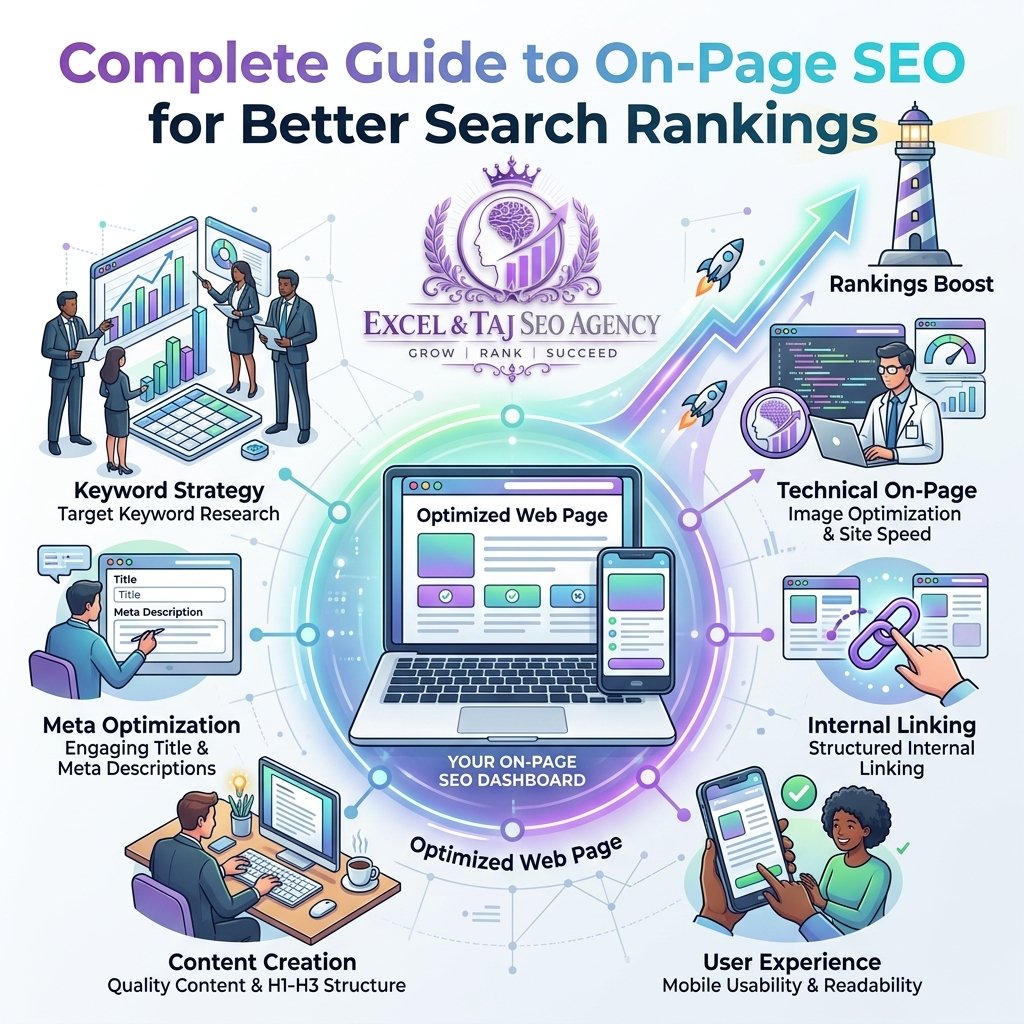
Important On-Page SEO elements include:
- Page titles
- Meta descriptions
- Headings
- Website content
- Keyword usage
- Search intent
- URLs
- Internal linking
- Images and alt text
- Content structure
- Readability
- User experience
The goal is not to insert keywords repeatedly. Instead, effective On-Page SEO helps search engines understand what a page is about while making the page genuinely useful to visitors.
Why On-Page SEO Is Important
Search engines need to understand the purpose and subject of a webpage before determining how it may be relevant to a user’s search.
Well-optimized pages provide clearer signals about their topic and structure.
On-Page SEO can help businesses:
- Improve organic search visibility
- Make webpages easier to understand
- Target relevant search queries
- Improve content relevance
- Create a better user experience
- Strengthen internal website structure
- Help visitors find useful information
- Support long-term SEO growth
On-Page SEO should also work together with technical SEO, content strategy, local SEO, and off-page SEO. No single optimization element guarantees a particular ranking position.
Understanding Search Intent Before Optimizing Content
One of the most important steps in On-Page SEO is understanding search intent.
Search intent describes what a person wants when they type a query into a search engine.
There are several common types of search intent.
Informational Intent
The user wants to learn something.
Examples include:
- What is On-Page SEO?
- How does keyword research work?
- What is technical SEO?
For these searches, detailed guides, tutorials, and educational articles may be appropriate.
Navigational Intent
The user is trying to find a specific website, brand, or page.
For example, someone may search for a particular company’s name to locate its official website.
Commercial Intent
The user is researching products or services before making a decision.
Examples include:
- Best SEO services for small businesses
- SEO agency comparison
- Professional SEO services
Transactional Intent
The user is ready to take an action, such as making a purchase, booking a service, or submitting an inquiry.
Understanding intent helps businesses create pages that satisfy the actual needs behind searches.
Keyword Research for On-Page SEO
Keyword research provides the foundation for many On-Page SEO campaigns.
Before optimizing a page, businesses should identify the terms their target audience uses when searching for relevant information, products, or services.
Keyword research can consider:
- Search volume
- Competition
- Relevance
- Search intent
- Long-tail variations
- Related terms
- Commercial value
For example, a website offering SEO services might target a primary phrase such as “On-Page SEO services” while also covering related terms such as:
- On-Page SEO optimization
- SEO content optimization
- Website SEO
- On-Page SEO techniques
- Search engine optimization
- SEO page optimization
Keywords should be incorporated naturally rather than repeated excessively.
Primary and Secondary Keywords
A page can have a primary keyword that represents its main topic.
Secondary keywords can provide additional context and help cover related subtopics.
For example:
Primary keyword: On-Page SEO
Related keywords:
- SEO optimization
- keyword optimization
- title tag optimization
- meta description
- internal linking
- SEO content
- heading structure
The purpose is to build comprehensive content around a topic rather than repeatedly using the same phrase.
Optimizing Page Titles
The page title is one of the most important elements of an optimized webpage.
A title should clearly communicate what the page is about and should be useful to people viewing search results.
A good title should generally be:
- Relevant to the page
- Clear and descriptive
- Naturally written
- Related to the primary topic
- Appealing to the intended audience
For example:
Complete Guide to On-Page SEO for Better Search Rankings
This title immediately communicates the subject and purpose of the article.
Avoid stuffing multiple keywords into a title simply to increase keyword density.
Writing Effective Meta Descriptions
A meta description provides a short summary of a webpage.
Although it is not simply a direct ranking formula, a useful description can help users understand what they may find on a page and can influence whether they choose to visit.
An effective meta description should:
- Summarize the page accurately
- Include relevant terminology naturally
- Explain the value of the page
- Encourage an appropriate action
- Match the actual content
For example, an SEO guide could describe the major On-Page SEO elements covered in the article.
Using Proper Heading Structure
Headings organize content and make long articles easier to understand.
A typical structure can include:
- H1 for the main page topic
- H2 for major sections
- H3 for supporting subsections
For example:
H1: Complete Guide to On-Page SEO
H2: Why On-Page SEO Matters
H2: Keyword Research
H3: Primary and Secondary Keywords
H2: Internal Linking
This structure helps readers scan content and understand how different sections relate to one another.
Creating High-Quality SEO Content
Content is one of the most important components of On-Page SEO.
Optimized content should be written for people first while naturally incorporating relevant search terms.
High-quality SEO content should:
- Answer the reader’s questions
- Provide useful information
- Match search intent
- Be original
- Use clear language
- Include appropriate examples
- Avoid unnecessary repetition
- Be easy to scan
Long content is not automatically better. A page should be as comprehensive as necessary to satisfy the topic and the user’s needs.
Content Depth and Topical Relevance
A comprehensive article should cover important aspects of its subject instead of focusing on one keyword repeatedly.
For an On-Page SEO guide, relevant topics might include:
- Keyword research
- Search intent
- Titles
- Meta descriptions
- Headings
- Content structure
- URLs
- Images
- Internal links
- User experience
Covering related concepts naturally can make an article more useful to readers.
Optimizing URLs
A clean URL structure can make webpages easier for users and search engines to understand.
A good URL should generally be:
- Short and descriptive
- Relevant to the page
- Easy to read
- Free from unnecessary parameters where possible
For example:
example.com/on-page-seo-guide
is easier to understand than a URL containing a long series of unrelated characters.
Avoid changing established URLs unnecessarily because URL changes can create redirects and other SEO considerations.
Internal Linking Strategy
Internal links connect pages within the same website.
A strong internal linking strategy helps users navigate between related resources and can help search engines discover and understand pages.
For example, an article about On-Page SEO could link naturally to pages covering:
- Keyword research
- Technical SEO
- SEO content writing
- Link building
- SEO audits
Benefits of Internal Linking
Internal links can:
- Improve navigation
- Help users discover related content
- Create topical relationships
- Support website architecture
- Help search engines find important pages
Anchor text should describe the destination naturally rather than using repetitive exact-match phrases throughout a website.
Image Optimization for On-Page SEO
Images can improve the visual quality of a webpage, but they should also be optimized properly.
Image optimization can include:
- Descriptive file names
- Appropriate image formats
- Image compression
- Responsive sizing
- Relevant alt text
Alt text is particularly useful for accessibility and helps communicate the purpose of an image when it cannot be displayed.
For example, instead of using a generic file name such as:
image123.jpg
a descriptive file name could be:
on-page-seo-checklist.jpg
Images should remain relevant to the content and should not be optimized in ways that make the page feel unnatural.
Mobile-Friendly Website Optimization
Many users access websites through smartphones and tablets.
A page that works well on mobile devices should have:
- Readable text
- Responsive design
- Easy navigation
- Properly sized buttons
- Fast-loading elements
- Content that fits the screen
Mobile usability is important not only for SEO but also for providing visitors with a positive experience.
Improving Page Experience
SEO should not be separated from user experience.
Visitors should be able to quickly understand:
- What the page is about
- Whether the information is relevant
- Where to find additional information
- What action they can take next
Good page experience can involve clear navigation, readable content, appropriate spacing, useful media, and efficient page performance.
Avoid overwhelming visitors with excessive pop-ups, distracting elements, or difficult navigation.
Page Speed and Core Web Vitals
Website performance can affect how users interact with a page.
Core Web Vitals are metrics used to evaluate aspects of page experience, including loading performance, responsiveness, and visual stability.
Businesses can improve performance by reviewing factors such as:
- Large image files
- Unnecessary scripts
- Browser caching
- Server response time
- Unused code
- Third-party resources
Technical performance should be evaluated as part of the broader SEO strategy rather than treated as an isolated task.
Schema Markup and Structured Data
Structured data provides search engines with additional information about the content of a webpage.
Depending on the website and page type, structured data may be relevant for content such as:
- Articles
- Products
- Organizations
- Events
- Local businesses
- FAQs
Structured data should accurately represent the visible content and follow applicable search engine guidelines.
It should not be used to provide misleading information.
SEO-Friendly Content Formatting
Even excellent information can be difficult to read if it is presented as a large block of text.
Use formatting techniques such as:
- Short paragraphs
- Bullet points
- Numbered lists
- Clear headings
- Bold emphasis where appropriate
- Tables when useful
- Examples
For long-form content, readers often scan the page before deciding which sections to read in detail.
Good formatting therefore supports both usability and engagement.
Common On-Page SEO Mistakes to Avoid
Understanding what not to do is just as important as knowing what to optimize.
Keyword Stuffing
Repeating a keyword unnaturally can make content difficult to read and may reduce its usefulness.
Use keywords where they make sense in context.
Duplicate Content
Publishing substantially duplicated content across multiple pages can create confusion and reduce the distinct value of those pages.
Each important page should serve a clear purpose.
Poor Heading Structure
Using headings randomly can make content difficult to navigate.
Keep the hierarchy logical and use headings to organize meaningful sections.
Ignoring Search Intent
A page can contain the correct keyword but still fail to satisfy what users actually want.
Always consider the reason behind the search.
Neglecting Internal Links
Important pages can become difficult to discover if they are poorly connected to the rest of the website.
Review internal links regularly and connect related content naturally.
Over-Optimizing Anchor Text
Using exactly the same keyword-rich anchor text repeatedly can look unnatural.
Anchor text should describe the linked page and fit naturally within the surrounding content.
On-Page SEO Checklist
Before publishing or updating a webpage, businesses can use a practical checklist:
Keyword and Content
- Identify a primary topic
- Understand search intent
- Research relevant keywords
- Cover important related subtopics
- Write useful and original content
Page Elements
- Create a descriptive title
- Write a useful meta description
- Use a clear H1
- Organize sections with H2 and H3 headings
- Keep the URL descriptive
Links
- Add relevant internal links
- Use natural anchor text
- Check for broken links
- Link important pages appropriately
Images
- Compress large images
- Use descriptive file names
- Add useful alt text
- Ensure images are responsive
Technical and UX
- Check mobile usability
- Review page speed
- Ensure the page can be crawled
- Check indexing settings
- Review Core Web Vitals
- Make navigation easy
Why Professional On-Page SEO Services Can Help
Optimizing a website manually can become complicated, especially when a business has many pages or operates in a competitive industry.
Professional SEO support can help identify opportunities and prioritize optimization tasks.
A professional approach can include:
- Website analysis
- Keyword research
- Search intent analysis
- Competitor research
- Content review
- Technical checks
- On-page optimization
- Internal linking improvements
- Performance monitoring
The strategy should be adapted to the website rather than applying the same checklist to every business.
Measuring On-Page SEO Performance
Optimization should be followed by monitoring and analysis.
Useful performance indicators can include:
- Organic traffic
- Search impressions
- Search clicks
- Keyword visibility
- Click-through rate
- Engagement metrics
- Conversions
- Indexed pages
Tools such as Google Search Console and analytics platforms can help website owners understand how pages are performing and identify areas for improvement.
SEO performance should be evaluated over an appropriate period because rankings and traffic can fluctuate for many reasons.
Building a Long-Term On-Page SEO Strategy
On-Page SEO should be treated as an ongoing process.
Search behavior changes, competitors publish new content, websites are updated, and search engines continually improve their systems.
A sustainable approach can follow this cycle:
Research → Optimize → Publish → Monitor → Improve
Businesses can regularly review older content, update outdated information, improve internal links, expand useful sections, and address technical issues.
This can help maintain the quality and relevance of a website over time.
Conclusion
On-Page SEO is a fundamental part of building a search-friendly website. It goes far beyond placing keywords on a webpage. Effective optimization combines keyword research, search intent, high-quality content, title and heading optimization, internal linking, image optimization, technical performance, mobile usability, and a strong user experience.
When these elements work together, search engines can better understand a website’s content while visitors can find and use the information more easily.
For businesses that want structured support, On-Page SEO services from Taj SEO Agency can be incorporated into a broader SEO strategy that may also include technical SEO, content writing, local SEO, link building, guest posting, and off-page optimization.
The most sustainable approach is to focus on relevance, usefulness, technical quality, and the needs of real users. By consistently reviewing and improving important website pages, businesses can build a stronger foundation for organic search visibility and long-term digital growth.
Frequently Asked Questions
1. What is On-Page SEO?
On-Page SEO is the process of optimizing elements within a webpage to improve its relevance, usability, and search visibility. It includes content, keywords, titles, headings, URLs, internal links, images, and other page elements.
2. Why is On-Page SEO important for rankings?
On-Page SEO helps search engines understand the subject and purpose of a webpage. It also helps create a better experience for visitors. While no individual SEO technique guarantees a specific ranking, proper optimization can provide a stronger foundation for organic search visibility.
3. How often should On-Page SEO be updated?
There is no universal schedule. Important pages should be reviewed when information becomes outdated, search intent changes, competitors introduce better resources, or performance data indicates an opportunity for improvement.
4. What is the difference between On-Page and Off-Page SEO?
On-Page SEO focuses primarily on elements within your website, such as content, headings, titles, URLs, and internal links. Off-Page SEO focuses on external signals and activities, such as relevant backlinks, outreach, digital PR, and brand mentions.
5. Can On-Page SEO improve website traffic?
Proper On-Page SEO can help search engines understand and match relevant webpages with search queries. If pages gain greater visibility for relevant searches, they may attract more organic visitors. Actual results depend on factors such as competition, content quality, website authority, technical performance, and search demand.