
Getting visitors to your website is important, but getting the right visitors is even more important. If people are searching for your products, services, or information and your website does not appear in search results, you may be missing valuable opportunities.
This is where a strong SEO strategy can make a difference.
Search engine optimization, commonly known as SEO, helps search engines understand your website and helps users discover relevant pages through search. Google explains that SEO is about helping search engines crawl, index, and understand your content while making it easier for people to find your website.
However, SEO is not about finding one secret trick that guarantees the first position on Google. A successful approach usually combines useful content, keyword research, technical improvements, internal linking, website experience, and regular performance analysis.
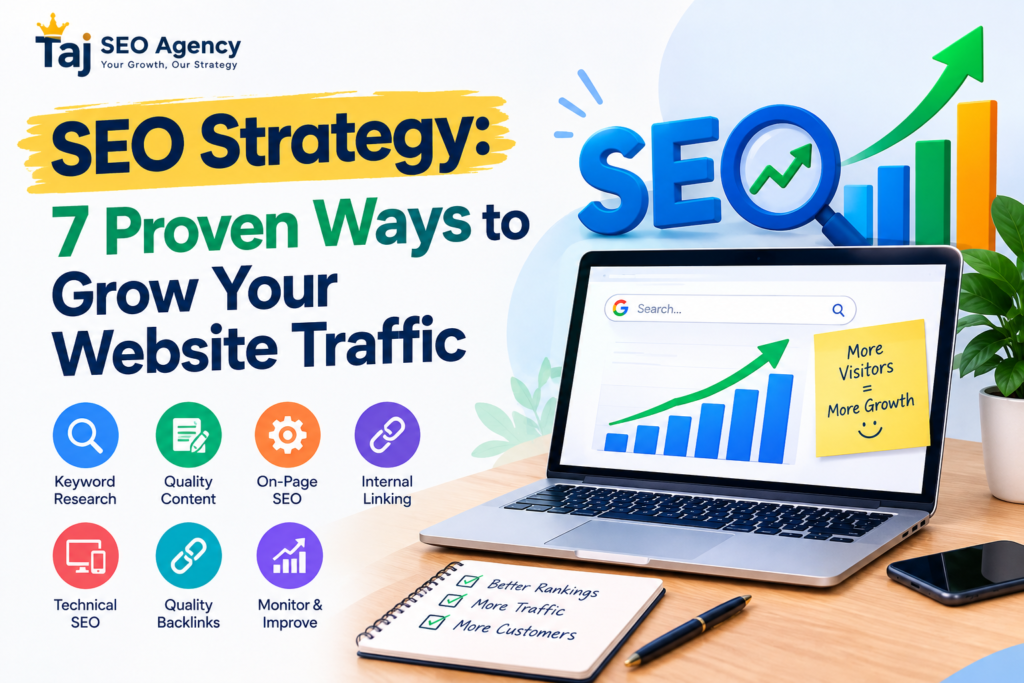
In this guide, we will discuss 7 proven ways to build an effective SEO strategy and grow your website traffic.
What Is an SEO Strategy?
An SEO strategy is a planned approach to improving your website’s visibility in search engines. It involves understanding what your audience searches for, creating useful content, optimizing your website, and monitoring your results.
For example, if you run a digital marketing agency, your audience may search for terms such as “SEO services,” “SEO agency,” “how to improve Google rankings,” or “SEO strategy for small businesses.”
Instead of creating random articles, you can build content around these topics and connect related pages together.
A good SEO strategy should focus on both search engines and real people. Google recommends creating helpful, reliable, people-first content rather than content created mainly to manipulate search rankings.
Why Is SEO Strategy Important for Website Traffic?
Organic search can help your website reach people who are already looking for information, products, or services related to your business.
Unlike simply publishing content and hoping people find it, SEO gives you a structured way to improve your online visibility.
A well-planned SEO strategy can help you:
- Increase relevant organic traffic
- Reach people searching for your services
- Improve website visibility
- Build brand awareness
- Create useful content for your audience
- Improve the overall structure of your website
- Understand what your audience wants
- Generate more potential leads and customers
SEO usually requires patience. Google notes that changes can take different amounts of time to appear in search results, ranging from relatively short periods to several months.
7 Proven Ways to Improve Your SEO Strategy
1. Start With Proper Keyword Research
Keyword research should be one of the first steps in your SEO strategy.
Keywords are the words and phrases people type into search engines when they are looking for something.
For example, someone interested in SEO may search for:
- SEO services
- SEO strategy
- best SEO agency
- SEO tips for beginners
- how to improve website ranking
- local SEO services
The goal is not to use every keyword you can find. Instead, choose keywords that are relevant to your business and match what your target audience actually wants.
You should also think about search intent. A person searching for “what is SEO” is probably looking for information, while someone searching for “hire SEO expert” may be closer to making a buying decision.
Google recommends thinking about the words users might search for when looking for your content and writing with those search behaviors in mind.
2. Create Helpful, Original Content
Content is one of the most important parts of a successful SEO strategy.
But simply publishing hundreds of articles is not the goal. Your content should answer real questions and provide useful information.
Before writing an article, ask yourself:
- Who is this content for?
- What problem does it solve?
- What information does the reader need?
- Can I explain the topic more clearly?
- Can I provide examples or practical steps?
- Does the article add something useful beyond existing content?
For example, instead of writing a general article called “SEO,” you could create a more focused guide such as “SEO Strategy for Small Businesses: 7 Practical Steps.”
Make your content easy to read by using short paragraphs, descriptive headings, bullet points, examples, and clear explanations.
Google’s SEO guidance emphasizes content that is useful, unique, well-organized, reliable, and written for people.
3. Optimize Your On-Page SEO
On-page SEO means improving the elements on your website pages so that users and search engines can better understand them.
Important on-page elements include:
- Page title
- Meta description
- Main heading
- Subheadings
- URL
- Body content
- Internal links
- Image alt text
Your primary keyword can be included naturally in important areas such as the title and main heading when appropriate.
For example, if your focus keyword is SEO Strategy, your title could be:
SEO Strategy: 7 Proven Ways to Grow Your Website Traffic
You can then naturally discuss the topic throughout the article and use related terms such as SEO planning, organic traffic, keyword research, content optimization, and website visibility.
Avoid repeating the same keyword unnecessarily. Keyword stuffing can make content difficult to read and does not create a good experience for visitors.
Google’s Search Essentials recommends using words that people would use to find your content in prominent and descriptive locations, including titles, headings, alt text, and link text.
4. Build a Strong Internal Linking Structure
Internal links connect one page of your website to another page on the same website.
They are useful for both visitors and search engines.
For example, if you publish an article about SEO strategy and already have another article about SEO tools, you can naturally link to that article from the new post.
You might write:
“Want to make your SEO work easier? Check out our guide to the best SEO tools.”
The link should point to the relevant page on your website.
Internal linking can help visitors discover related information and can make it easier for search engines to discover and understand pages across your website. Google notes that links are an important way its systems discover pages.
When adding internal links, use descriptive anchor text rather than generic phrases such as “click here.”
5. Improve Technical SEO and Website Experience
Even great content can struggle if your website has technical problems.
Your SEO strategy should therefore include basic technical SEO.
Check whether:
- Your website works well on mobile devices
- Important pages can be crawled
- Pages can be indexed
- Your website uses HTTPS
- Links work correctly
- Images are optimized
- Pages load efficiently
- Your navigation is easy to understand
- There are unnecessary technical errors
Google’s developer guidance recommends making websites secure, fast, accessible, and usable across devices.
You do not need to become a technical expert to start. Begin with the most obvious issues and gradually improve your website.
Google Search Console can also help website owners monitor search performance and identify certain search-related issues.
6. Earn Quality Backlinks
Backlinks are links from other websites to your website.
When relevant and trustworthy websites link to your content, those links can help people discover your website and can contribute to your site’s overall search presence.
However, you should focus on earning relevant, natural links rather than trying to collect as many links as possible.
Some ways to attract backlinks include:
- Publishing original research
- Creating useful guides
- Developing helpful resources
- Publishing statistics or studies
- Creating shareable visual content
- Writing valuable guest contributions where appropriate
- Promoting useful content to relevant websites and communities
The best reason for another website to link to your page is that your content provides something genuinely useful to its audience.
Avoid shortcuts that involve manipulative link-building practices. A sustainable SEO strategy should focus on creating value first.
7. Monitor Results and Improve Your Strategy
SEO should not be a one-time task.
Search behavior changes. Competitors publish new content. Your own website grows. Some pages perform well while others may need improvement.
That is why tracking your performance is an important part of your SEO strategy.
Google Search Console can help you understand how your website performs in Google Search.
Depending on your goals, you can monitor:
- Organic clicks
- Search impressions
- Click-through rate
- Average search position
- Pages receiving organic traffic
- Search queries bringing visitors
- Leads or conversions
- Content performance
If an article receives impressions but few clicks, you might review its title and meta description.
If a page receives traffic but does not generate leads, you might improve its content, calls to action, or service information.
The important thing is to use data to identify opportunities and then test reasonable improvements.
How to Create an SEO Strategy for a Small Business
Small businesses do not need to try to optimize everything at once.
Start with a simple plan.
First, identify the services or products that matter most to your business. Then research the searches your potential customers may use.
Next, create useful pages around those topics.
For example, an SEO agency could create pages such as:
- SEO Services
- Local SEO Services
- Technical SEO
- SEO Strategy
- SEO Tools
- SEO Tips for Beginners
You can then create supporting blog articles that answer specific questions and internally link them to relevant service pages.
This approach creates a clear relationship between informational content and commercial pages.
Common SEO Strategy Mistakes to Avoid
While working on SEO, avoid focusing only on search engines.
Some common mistakes include:
Keyword Stuffing
Repeating the same keyword again and again can make your content unnatural.
Use keywords where they make sense and focus on explaining the topic clearly.
Copying Competitors
Looking at competing pages can help you understand what information users expect, but copying their content will not give your audience additional value.
Create original content based on your own research, knowledge, experience, and audience needs.
Ignoring Search Intent
A keyword may look attractive, but if your page does not satisfy the reason behind the search, visitors may not find it useful.
Always ask what the user actually wants to accomplish.
Publishing Without Updating
Some content becomes outdated over time.
Review important articles periodically and update information when necessary. Google recommends keeping content useful and up to date.
Expecting Instant Results
SEO is generally a long-term process. Some changes may take weeks or months to show meaningful results, so give your strategy enough time to evaluate performance.
SEO Strategy and People-First Content
A strong SEO strategy should never forget the person behind the search query.
Imagine someone visits your article after searching for a solution. They should quickly understand what the page is about, find useful information, and leave with a better understanding of the topic.
Google’s guidance encourages website owners to ask whether their content is genuinely useful to their intended audience and whether readers leave feeling they have learned enough to achieve their goal.
That means your priority should be quality, clarity, usefulness, and trust.
SEO techniques should support good content—not replace it.
Final Thoughts
Building website traffic takes more than publishing a few blog posts. You need a clear and consistent SEO strategy that combines keyword research, useful content, on-page optimization, internal linking, technical SEO, quality backlinks, and regular performance analysis.
The good news is that you do not have to improve everything overnight.
Start with the pages that matter most to your business. Understand what your audience is searching for, create genuinely useful content, improve your website experience, and monitor your results.
Over time, these small improvements can build a stronger search presence and help your website attract more relevant visitors.
If you want professional help with SEO, Taj SEO Agency can help businesses improve their online visibility through a structured approach to search engine optimization.
Visit Taj SEO Agency at https://tajseoagency.com/ to learn more about SEO and digital marketing services.