
Introduction
Businesses today need more than just an online presence to succeed. Having a website, publishing content, and creating social media profiles are important steps, but they do not automatically bring customers or generate revenue. Companies need marketing strategies that attract the right audience, build trust, and turn website visitors into paying customers. This is where SEO performance marketing becomes valuable.
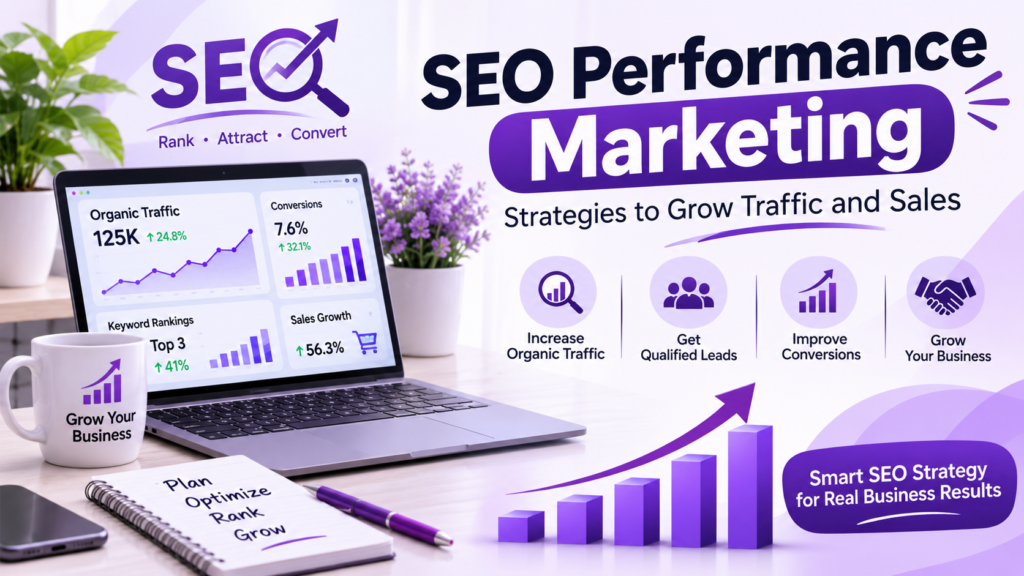
SEO performance marketing combines search engine optimization with measurable marketing goals. Instead of focusing only on website rankings or increasing organic traffic, it looks at how SEO contributes to real business results, such as qualified leads, customer inquiries, conversions, and sales.
Traditional SEO often focuses on improving keyword rankings, website visibility, and organic traffic. Performance marketing takes the strategy further by connecting marketing activities with measurable outcomes. When these approaches work together, businesses can understand which SEO activities are delivering value and where improvements are needed.
For small businesses, online stores, service providers, and established companies, this approach can create a more sustainable way to attract customers. It helps businesses make informed decisions, use marketing budgets wisely, and build long-term visibility in search engines.
What Is SEO Performance Marketing?
SEO performance marketing is a digital marketing approach that combines organic search optimization with performance-based measurement. Its main purpose is to improve a website’s visibility while tracking how that visibility contributes to business growth.
The strategy focuses on attracting users who are actively searching for products, services, or information related to a business. It then improves the website experience and content to encourage those visitors to take meaningful actions.
For example, imagine a company offering web development services. Its potential customers may search Google for phrases such as professional web development services, affordable website design, or business website development.
A well-planned SEO performance marketing strategy helps the company appear in relevant search results. However, ranking is only one part of the process. The website also needs helpful service pages, clear information, strong calls to action, and an easy inquiry process.
If visitors arrive but leave without contacting the company, the marketing strategy may need improvement. Measuring user behavior and conversions helps identify these problems.
The key difference is that success is not measured by traffic alone. It is measured by the quality of that traffic and the business value it generates.
How SEO Performance Marketing Works
SEO performance marketing works through a continuous process of research, optimization, implementation, and performance measurement.
The process usually begins with understanding the business, its target audience, and its marketing objectives. A company that wants more online sales needs a different strategy from a business that wants more consultation bookings or local service inquiries.
Once the objectives are clear, SEO professionals research the search terms potential customers use. They examine search intent, competitors, website performance, content quality, and technical issues.
The next step is improving the website so search engines can understand its content and users can easily find the information they need.
Content optimization, technical SEO, link building, and conversion optimization all contribute to the process. Performance data is then reviewed to understand which activities are producing positive results.
For example, a website may receive 5,000 monthly visitors but generate very few inquiries. Increasing traffic further may not solve the problem. The business may need better-targeted keywords, improved service pages, stronger trust signals, or a simpler contact form.
This is why measuring the complete customer journey is important.
The Role of Keyword Research in Performance Marketing
Keyword research is one of the most important foundations of an effective SEO strategy. It helps businesses understand what their potential customers are searching for and what type of information they expect to find.
Not every keyword brings the same value. Some search terms attract people who are simply looking for general information, while others indicate that users are ready to compare services or make a purchase.
Understanding this difference allows marketers to target keywords that match business goals.
Understanding Search Intent
Search intent refers to the reason behind a user’s search query. It helps SEO professionals understand what someone wants when they enter a particular phrase into Google.
Informational searches are usually made by people looking for answers, explanations, or guidance. Commercial searches come from users researching different products or services before making a decision. Transactional searches indicate stronger purchasing intent, while navigational searches are used to find a particular website or brand.
A successful SEO performance marketing campaign considers all these search behaviors.
For example, someone searching for “what is technical SEO” may be researching a topic. Someone searching for “technical SEO services” is more likely to be considering professional assistance.
Businesses should create relevant content for each stage of the customer journey instead of targeting keywords without understanding their purpose.
On-Page SEO and Its Impact on Performance
On-page SEO involves optimizing individual website pages to improve their relevance, readability, and search engine understanding.
It helps search engines identify the subject of a page and determine whether its content is useful for a particular search query.
Important on-page elements include title tags, meta descriptions, headings, URL structure, internal links, image optimization, and content quality.
A properly optimized page should have a clear topic and provide useful information without unnecessarily repeating keywords.
For example, a digital marketing agency offering SEO services should create dedicated pages explaining its on-page SEO, technical SEO, local SEO, and link-building services.
Each page should address the audience’s needs, explain the service, demonstrate expertise, and provide a clear way to contact the company.
Good on-page SEO also improves the experience of website visitors. When users can quickly understand what a business offers, they are more likely to explore its services and consider taking action.
Technical SEO: Building a Strong Website Foundation
Technical SEO focuses on improving the technical structure of a website so search engines can crawl, understand, and index its pages effectively.
Even high-quality content may struggle to perform if a website has serious technical problems.
Website speed is an important part of the user experience. Slow-loading pages can frustrate visitors, particularly those using mobile devices. Businesses should optimize images, reduce unnecessary scripts, use efficient caching, and improve server performance.
Mobile responsiveness is equally important. A website should display properly across smartphones, tablets, and desktop screens.
Other important technical areas include XML sitemaps, robots.txt configuration, HTTPS security, canonical tags, structured data, crawlability, and indexability.
Google Search Console can help website owners identify indexing problems, monitor search performance, and understand how Google interacts with their websites.
Technical SEO does not guarantee higher rankings on its own. Its purpose is to remove technical barriers and create a reliable foundation for other SEO activities.
Content Marketing and SEO Performance
Content plays a major role in attracting organic visitors and building relationships with potential customers.
People use search engines to find solutions to problems, compare products, understand services, and make informed decisions. Businesses that publish genuinely helpful content can reach these audiences at different stages of their buying journey.
SEO-focused content marketing involves creating articles, landing pages, service descriptions, case studies, and other resources that match relevant search queries.
However, publishing a large number of articles does not automatically improve website performance. Content must be relevant, accurate, original, and useful.
A business offering digital marketing services could publish educational articles about keyword research, local SEO, website audits, content optimization, and link building.
These articles can attract users who are researching digital marketing solutions. Internal links can then guide interested readers toward relevant service pages.
Content should also be updated when information becomes outdated or when search behavior changes.
The objective is to create resources that help readers make better decisions while supporting the business’s visibility in search engines.
Off-Page SEO and High-Quality Backlinks
Off-page SEO refers to activities performed outside a website to improve its reputation, authority, and online visibility.
Backlinks are an important part of off-page SEO. A backlink is a link from another website pointing to your website.
When relevant and trustworthy websites link to useful content, these links can help search engines discover pages and understand their relationships with other resources.
However, not all backlinks provide the same value.
A link from a relevant, established website can be more meaningful than multiple links from unrelated or low-quality websites.
Businesses should focus on earning links through valuable content, genuine industry relationships, digital PR, relevant guest posting, and useful resources.
Guest posting can also help brands reach new audiences when articles are published on websites that are relevant to their industry.
The focus should remain on quality, relevance, and natural link-building practices rather than simply increasing backlink numbers.
Conversion Rate Optimization: Turning Traffic into Customers
One of the most important elements of SEO performance marketing is conversion rate optimization, commonly known as CRO.
Getting visitors to a website is useful, but businesses also need those visitors to take meaningful actions.
A conversion may involve purchasing a product, submitting a contact form, requesting a quotation, booking an appointment, or signing up for a newsletter.
Conversion rate optimization focuses on identifying and removing barriers that prevent visitors from completing these actions.
For example, an online store may receive thousands of organic visitors but generate fewer purchases than expected. The issue could be complicated navigation, unclear product descriptions, unexpected delivery costs, slow checkout pages, or a lack of trust signals.
Improving these areas can help the business generate more value from its existing traffic.
Service-based businesses can improve conversions by displaying clear service information, customer testimonials, contact details, project examples, and visible inquiry buttons.
SEO and conversion optimization should work together. A website needs relevant visitors as well as a user-friendly experience that encourages them to become customers.
Important SEO Performance Marketing Metrics
Measuring performance helps businesses understand whether their SEO activities are supporting their objectives.
Without reliable data, it becomes difficult to identify successful campaigns or understand why results are not improving.
Organic traffic is one of the basic SEO metrics. It shows how many visitors reach a website through unpaid search results. However, traffic numbers should always be considered alongside visitor quality and engagement.
Keyword rankings help marketers understand how website pages perform for targeted search terms. They can also reveal opportunities to improve content and search visibility.
Click-through rate measures how often users click a search result after seeing it. Search Console provides impressions, clicks, and average click-through rate for websites appearing in Google Search.
Conversion rate shows the percentage of visitors who complete a desired action. This is particularly important for businesses that depend on inquiries, leads, or online purchases.
Cost per acquisition measures how much a business spends to acquire a customer. For paid campaigns, it can be calculated by dividing advertising costs by the number of acquired customers. Organic SEO also has costs, including content production, technical work, and agency services, which can be considered when evaluating overall acquisition costs.
Return on investment helps businesses compare the value generated by marketing activities with the costs involved.
Google Analytics 4 can help track website activity and conversions, while Google Search Console provides valuable information about organic search performance.
The most useful metrics depend on the business model. An online store may prioritize revenue and purchases, while a local service provider may focus on qualified leads and calls.
SEO Performance Marketing for Small Businesses
Small businesses often work with limited marketing budgets. They need strategies that provide sustainable value without requiring unnecessary spending.
SEO performance marketing can help smaller companies compete by targeting specific audiences and relevant search queries.
A local business, for example, can focus on location-based keywords, Google Business Profile optimization, customer reviews, and locally relevant website content.
An online service provider can target keywords related to its services and publish helpful articles that answer common customer questions.
An e-commerce business can optimize product pages, category pages, product descriptions, and technical website elements to improve organic visibility.
The advantage of SEO is that businesses can continue receiving organic traffic from useful content and well-optimized pages after the initial work has been completed.
However, SEO is a long-term strategy. Results depend on competition, website condition, industry, content quality, and other factors. Businesses should avoid expecting guaranteed rankings or immediate sales.
A consistent strategy supported by performance data is more valuable than making random website changes without clear objectives.
SEO Performance Marketing vs Traditional Digital Marketing
Traditional digital marketing often focuses on increasing brand awareness and reaching audiences through different channels. These channels can include television, print advertising, social media, email campaigns, and online advertising.
SEO performance marketing has a more specific focus on organic search visibility and measurable business outcomes.
It connects search engine optimization with the broader goal of attracting relevant visitors and encouraging conversions.
Paid search advertising can also support this strategy. Businesses can use Google Ads to reach potential customers immediately while building organic search visibility through SEO.
The two approaches serve different purposes.
Paid campaigns can generate visibility while advertising budgets are active. Organic SEO aims to develop sustainable search visibility over time.
Combining both approaches can help businesses understand customer search behavior, test marketing messages, and reach potential customers through multiple channels.
The right combination depends on the company’s budget, competition, target audience, and business objectives.
Tools Used in SEO Performance Marketing
Professional SEO work requires reliable tools to research keywords, monitor website health, analyze competitors, and measure results.
Google Search Console is useful for understanding organic search performance, indexing issues, and search queries that generate impressions and clicks.
Google Analytics 4 helps businesses analyze website traffic, user behavior, and conversion events.
Ahrefs provides tools for backlink analysis, keyword research, competitor research, and content opportunities.
Semrush offers keyword research, competitor analysis, site auditing, rank tracking, and other digital marketing features.
Screaming Frog SEO Spider can help identify technical issues such as broken links, missing metadata, redirect problems, and duplicate page elements.
PageSpeed Insights helps evaluate website performance and provides suggestions for improving loading speed and user experience.
Rank Math is another useful WordPress SEO plugin that helps website owners manage metadata, sitemaps, structured data, and on-page optimization.
These tools support decision-making, but tools alone do not create successful campaigns. Results depend on how accurately marketers interpret the information and apply the right improvements.
Common Mistakes That Reduce SEO Performance
Many businesses invest in SEO but struggle to achieve meaningful results because their strategies are not aligned with customer needs.
One common mistake is focusing only on keyword rankings. A website may rank for several search terms without attracting users who are interested in its products or services.
Another problem is publishing content without proper keyword research or search intent analysis. Content that does not answer the audience’s questions may receive limited engagement.
Ignoring technical SEO can also affect performance. Indexing problems, broken pages, poor mobile usability, and slow-loading websites can create unnecessary barriers.
Low-quality link building is another risk. Purchasing large quantities of irrelevant backlinks may create an unnatural backlink profile without delivering meaningful business value.
Some businesses also fail to track conversions. They monitor traffic increases but do not measure whether visitors are becoming customers.
The solution is to develop a complete strategy that connects keyword targeting, technical improvements, content quality, authority building, user experience, and conversion tracking.
How to Build an Effective SEO Performance Marketing Strategy
A successful campaign begins with clear business objectives. A company should understand whether it wants more organic traffic, qualified leads, online sales, local customers, or stronger brand visibility.
The website should then be audited to identify technical errors, content gaps, keyword opportunities, and weaknesses in the user experience.
Keyword research should focus on relevant searches that match the company’s services and customer needs. Competitor analysis can help identify content opportunities and understand the level of competition.
The next stage involves optimizing important landing pages, improving website structure, publishing helpful content, and developing a relevant backlink strategy.
Conversion tracking should be configured so that businesses can measure meaningful actions rather than relying only on traffic reports.
Performance should be reviewed regularly. If a page receives impressions but few clicks, its search appearance may need improvement. If it receives traffic but few inquiries, the content, user experience, or conversion process may need attention.
SEO is not a one-time activity. Search trends, competitors, customer expectations, and search engine systems continue to change. Regular analysis and improvement help businesses maintain their online presence.
The Future of SEO Performance Marketing
The digital marketing industry continues to evolve as search technology, artificial intelligence, and user behavior change.
Search engines are becoming better at understanding the meaning and context behind queries. This makes useful, relevant, and well-structured content increasingly important.
Businesses should focus on answering real customer questions instead of creating pages solely to target individual keywords.
AI-powered tools can support keyword research, content planning, competitor analysis, and reporting. However, human expertise remains important for checking accuracy, understanding customer needs, developing marketing strategies, and maintaining content quality.
Brand credibility, topical relevance, customer experience, and original information will remain important considerations for businesses that want to build a sustainable online presence.
SEO performance marketing will continue to focus on measurable outcomes. Companies will increasingly evaluate their marketing strategies based on the quality of leads, customer acquisition, revenue contribution, and long-term business growth.
Conclusion
SEO performance marketing is more than a strategy for improving website rankings. It connects search engine optimization with measurable business objectives, helping companies attract relevant visitors and turn online visibility into meaningful results.
From keyword research and technical SEO to content marketing, backlinks, conversion optimization, and performance tracking, every part of the strategy contributes to the overall customer experience.
Businesses that focus only on traffic may miss valuable opportunities. By measuring the quality of visitors, understanding customer intent, and continuously improving their websites, companies can build a stronger digital presence.
A well-planned SEO performance marketing strategy requires consistency, reliable data, and a clear understanding of business goals. When these elements work together, SEO can become a valuable long-term investment for sustainable online growth.
Frequently Asked Questions (FAQs)
What is SEO performance marketing?
SEO performance marketing is an approach that combines search engine optimization with measurable marketing objectives. It focuses on improving organic search visibility while tracking results such as qualified traffic, leads, conversions, and sales.
How does SEO performance marketing help businesses?
It helps businesses attract people who are actively searching for relevant products or services. By improving website visibility, content quality, and user experience, companies can generate more relevant visitors and increase opportunities for customer inquiries and sales.
What are the most important SEO performance marketing metrics?
Important metrics include organic traffic, keyword rankings, impressions, click-through rate, conversion rate, qualified leads, customer acquisition cost, and return on investment. Businesses should choose metrics according to their marketing objectives.
How long does SEO performance marketing take to show results?
SEO results vary depending on website condition, competition, industry, content quality, and the strategy being implemented. Some improvements may become visible within a few weeks, while meaningful organic growth often requires several months of consistent work. No agency can honestly guarantee a specific ranking or timeline.