
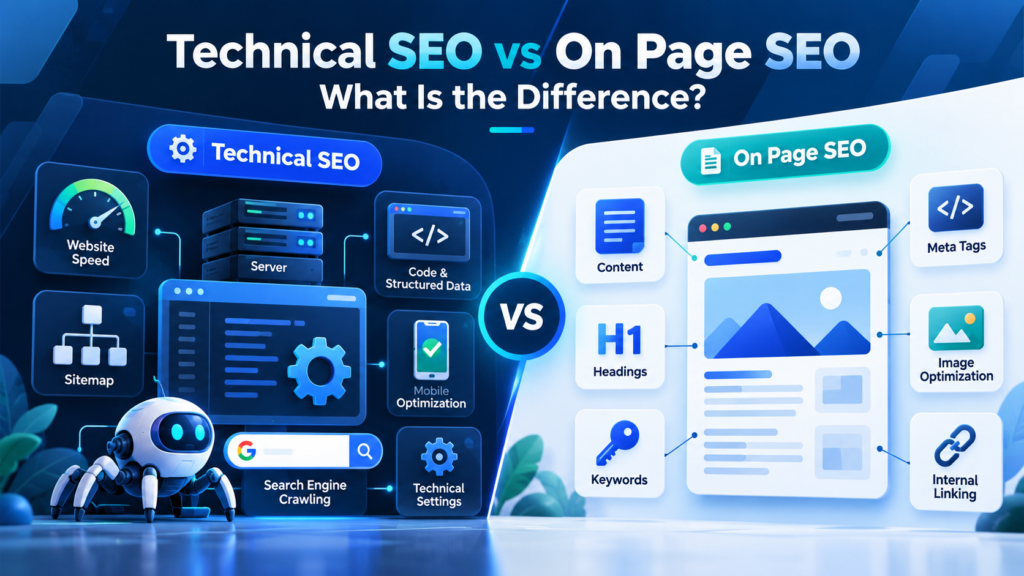
Search Engine Optimization (SEO) is one of the most important strategies for businesses that want to increase their online visibility. However, many website owners confuse different parts of SEO and do not understand how they work together. Two of the most important areas of SEO are Technical SEO and On Page SEO. Understanding Technical SEO vs On Page SEO helps businesses identify which improvements are needed to achieve better search engine performance.
Both strategies have different purposes, but they work together to improve website rankings, user experience, and organic traffic. Technical SEO vs On Page SEO mainly differs in their approach: Technical SEO focuses on improving the technical foundation of a website so search engines can easily crawl and understand it, while On Page SEO focuses on optimizing the content and elements visible on individual web pages.
For businesses working with a professional SEO company like Taj SEO Agency, understanding the difference between these two SEO methods helps create a stronger digital marketing strategy. A proper balance between Technical SEO and On Page SEO allows websites to improve visibility, attract more visitors, and build long-term online growth.
What Is Technical SEO?
Technical SEO vs On Page SEO ko samajhne ke liye pehle Technical SEO ka role samajhna zaroori hai. Technical SEO refers to the process of improving the technical structure and performance of a website. It focuses on making a website easier for search engines like Google to crawl, index, and understand.
Think of Technical SEO vs On Page SEO like the foundation and design of a building. Technical SEO works as the foundation that keeps a website strong and accessible. A beautiful building cannot perform well if its foundation is weak. Similarly, even high-quality content may struggle to rank if a website has technical problems.
Technical SEO usually works behind the scenes and includes areas such as website speed, mobile performance, security, website architecture, indexing, and search engine accessibility. When comparing Technical SEO vs On Page SEO, both areas are essential because technical improvements help search engines access a website, while On Page SEO improves content quality and relevance for users.
Important Elements of Technical SEO
Website Speed Optimization
Website loading speed plays an important role in user experience and is one of the key factors considered in Technical SEO vs On Page SEO strategies. Visitors usually leave websites that take too long to load, and search engines also consider website performance when evaluating pages.
As part of Technical SEO vs On Page SEO, Technical SEO specialists focus on improving the technical performance of a website by optimizing different elements such as:
- Image sizes
- Website code
- Server performance
- Browser caching
- Unnecessary scripts
Improving these technical factors helps search engines crawl websites more effectively and provides users with a faster browsing experience. When comparing Technical SEO vs On Page SEO, website speed optimization is an important part of Technical SEO because it directly affects performance, usability, and search visibility.
A faster website provides a better experience for visitors and helps search engines access content efficiently.
Mobile-Friendly Website
Most internet users browse websites through mobile devices. A website that does not work properly on smartphones can lose visitors and rankings.
Mobile SEO improvements include:
- Responsive design
- Easy navigation
- Proper text size
- Fast mobile loading speed
A professional SEO strategy ensures that websites provide a smooth experience across all devices.
Website Crawling and Indexing
Search engines use bots to discover and analyze websites. If search engines cannot properly crawl a website, important pages may not appear in search results.
Technical SEO helps improve:
- XML sitemap setup
- Robots.txt configuration
- Indexing problems
- Broken pages
- Redirect issues
Proper crawling allows search engines to understand which pages should appear in search results.
Website Security (HTTPS)
Security is another important technical factor. Websites using HTTPS protect user information and create more trust among visitors.
A secure website improves credibility and provides a safer browsing experience.
Structured Data and Schema Markup
Schema markup helps search engines better understand website content. It can provide additional information about pages, products, reviews, services, and businesses.
For example, structured data can help search engines understand:
- Business details
- Reviews
- Product information
- Frequently asked questions
This can improve how websites appear in search results.
What Is On Page SEO?
On Page SEO focuses on optimizing individual pages of a website to improve rankings and provide better value to users.
Unlike Technical SEO, which mainly focuses on the backend structure, On Page SEO deals with content and visible page elements.
The goal of On Page SEO is to help search engines understand what a page is about while making the content useful and engaging for visitors.
Important Elements of On Page SEO
Keyword Optimization
Keywords are the phrases people type into search engines when looking for information, products, or services.
Effective On Page SEO includes placing keywords naturally in:
- Page titles
- Headings
- Introduction
- Content sections
- Meta descriptions
- Image alt text
However, modern SEO is not about repeating keywords excessively. Search engines focus more on content quality, relevance, and user intent.
SEO-Friendly Content
Content is one of the most important parts of On Page SEO. A properly optimized article should answer the user’s questions and provide valuable information.
High-quality SEO content includes:
- Clear explanations
- Relevant examples
- Proper structure
- Helpful information
- Natural keyword usage
Businesses use content marketing to attract visitors and build trust with their audience.
Title Tags and Meta Descriptions
Title tags and meta descriptions help users understand what a page offers before clicking.
A strong title should:
- Include the main keyword
- Clearly describe the page
- Encourage users to click
A well-written meta description can improve click-through rates from search results.
Internal Linking
Internal links connect different pages within the same website.
They help:
- Visitors discover more content
- Search engines understand website structure
- Spread authority between pages
For example, a blog about SEO tips can link to a page about SEO services.
Image Optimization
Images improve content quality, but they should also be optimized.
Image SEO includes:
- Proper file size
- Descriptive file names
- Alt text
- Fast loading
Optimized images improve user experience and help search engines understand visual content.
Technical SEO vs On Page SEO: Key Differences
| Technical SEO | On Page SEO |
| Focuses on website infrastructure | Focuses on page content |
| Works mostly behind the scenes | Visible to users |
| Improves crawling and indexing | Improves relevance and user experience |
| Includes speed, security, mobile optimization | Includes keywords, content, titles, internal links |
| Requires technical knowledge | Requires content and SEO strategy |
Both areas are necessary because a website needs both technical strength and valuable content to achieve long-term SEO success.
Why Technical SEO and On Page SEO Are Both Important
Many businesses make the mistake of focusing only on content creation while ignoring technical issues. Others improve technical performance but do not create valuable content.
A successful SEO strategy requires balance.
For example:
- A website with excellent content but poor speed may lose visitors.
- A technically perfect website without useful content may not attract users.
- A website with both strong technical SEO and optimized content has better opportunities to grow.
Technical SEO creates the foundation, while On Page SEO builds the information users need.
How Taj SEO Agency Uses SEO Strategies for Better Results
A professional SEO agency combines different SEO techniques to improve website visibility. At Taj SEO Agency, SEO strategies focus on improving website performance, optimizing content, and creating a better experience for users.
A complete SEO approach usually includes:
- Website analysis
- Technical SEO audits
- Keyword research
- Content optimization
- On Page improvements
- Performance monitoring
Every website has different challenges, so SEO strategies should be customized according to business goals and target audiences.
Common Technical SEO Problems That Affect Rankings
Some common technical problems include:
Slow Website Loading
Slow pages create poor user experiences and may reduce engagement.
Broken Links
Broken links can make navigation difficult and affect website quality.
Duplicate Content Issues
Duplicate content can confuse search engines about which page should rank.
Poor Website Structure
A confusing website structure makes it harder for users and search engines to find important pages.
Missing Mobile Optimization
Websites that are difficult to use on mobile devices may lose potential customers.
Common On Page SEO Mistakes
Businesses often make these On Page SEO mistakes:
Keyword Stuffing
Using keywords too many times makes content unnatural and can reduce user experience.
Low-Quality Content
Short or unhelpful content does not satisfy user searches.
Ignoring Search Intent
Content should match what users actually want to find.
Poor Headlines
Titles and headings should clearly explain the topic and attract attention.
Missing Internal Links
Without internal links, users may leave after reading one page.
Which One Is More Important: Technical SEO or On Page SEO?
Technical SEO and On Page SEO are not competitors. They are two parts of the same SEO system.
Technical SEO ensures that search engines can access and understand your website, while On Page SEO ensures that your content provides value to users.
A website needs both to achieve sustainable organic growth.
A technically strong website with poor content will struggle to attract visitors. Similarly, excellent content on a website with technical problems may not reach the right audience.
The best approach is to improve technical performance while continuously creating and optimizing valuable content.
Final Thoughts
Technical SEO and On Page SEO are essential parts of a successful search engine optimization strategy. Technical SEO creates a strong foundation by improving website performance, accessibility, and search engine crawling. On Page SEO improves content quality, keyword targeting, and user experience.
For businesses that want to increase online visibility, investing in both areas can help build a stronger digital presence.
With the right SEO strategy, businesses can improve rankings, attract more organic visitors, and create better connections with their target audience.
Taj SEO Agency helps businesses develop effective SEO strategies that combine technical improvements with powerful content optimization to support long-term online growth.