
Having a website is an important step for any business, but simply having a website does not guarantee that people will find it through Google. If your pages do not appear when potential customers search for your products, services, or information, you may miss valuable traffic and business opportunities.
This is where On-Page SEO becomes important. It is the process of improving the different elements of your website pages so search engines can better understand your content and visitors can easily find useful information.
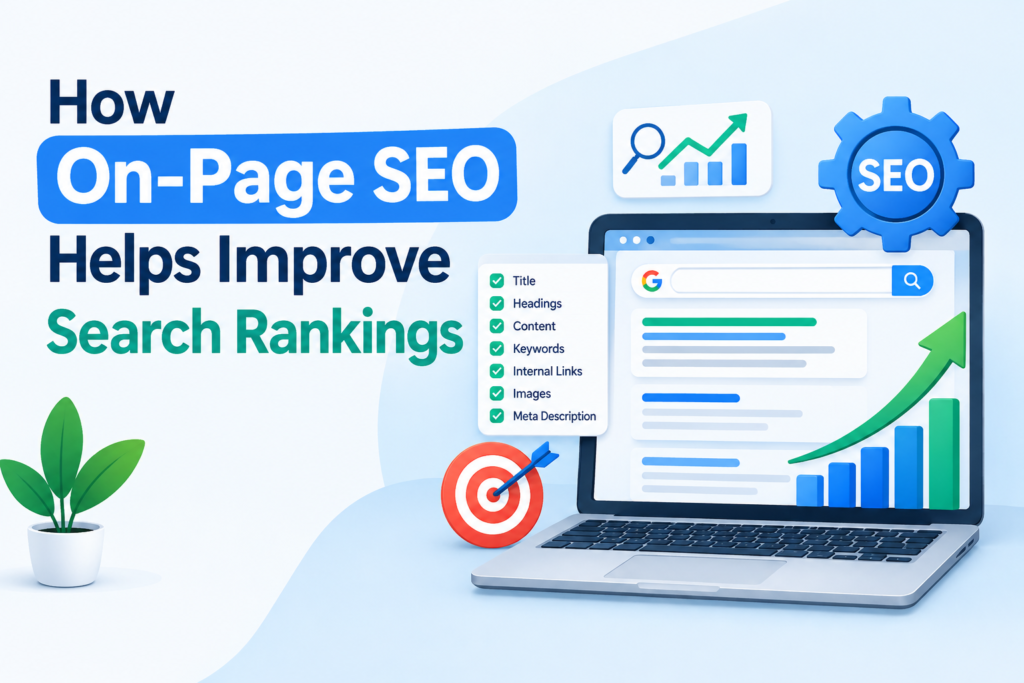
On-Page SEO includes many areas of a webpage, including titles, headings, keywords, content, URLs, internal links, images, and page structure. When these elements are properly optimized, your pages become clearer, more useful, and more relevant to the searches you want to target.
The goal is not to fill a page with keywords. Instead, On-Page SEO is about creating helpful content and making sure every important part of a webpage supports the needs of your audience.
In this guide, we will explain how On-Page SEO works, why it matters, and how you can use it to build pages that have a stronger foundation for search visibility.
What Is On-Page SEO?
On-Page SEO is the practice of optimizing individual webpages to improve their relevance, structure, usability, and visibility in search engines.
Unlike off-page SEO, which focuses on activities outside your website, On-Page SEO takes place directly on your own webpages. This means you have considerable control over many of the elements involved.
Important areas of On-Page SEO include:
- Page titles
- Headings
- Website content
- Keywords
- URLs
- Meta descriptions
- Internal links
- Images and alt text
- Page structure
- Mobile usability
- Page experience
- Structured data where appropriate
For example, if you have a page about SEO services, you can improve that page by creating a clear title, writing useful content, using relevant headings, adding internal links, and making the page easy to navigate.
For businesses that need professional assistance, On-Page SEO services can help identify optimization opportunities and improve important pages as part of a wider SEO strategy.
Why Is On-Page SEO Important?
Search engines need to understand the topic and purpose of a webpage before they can determine whether it may be useful for a particular search.
Imagine that you have written a detailed article about SEO for small businesses. The information may be valuable, but if the page has an unclear title, poor headings, confusing navigation, and weak content structure, both visitors and search engines may have difficulty understanding it.
This is why On-Page SEO is important.
A properly optimized webpage can help you:
- Communicate the main topic clearly
- Improve content relevance
- Make information easier to read
- Help visitors navigate your website
- Support search engine understanding
- Target relevant search queries
- Create a better overall user experience
However, On-Page SEO does not guarantee a specific Google ranking. Search engines use many different signals when determining which pages are useful for a particular search.
Google recommends creating helpful, reliable, people-first content rather than content designed mainly to manipulate search rankings.
1. Optimize Your Page Title
The page title is an important part of On-Page SEO because it tells users and search engines what a webpage is about.
A good title should be clear, relevant, and connected to the actual content on the page.
For example:
Weak title:
SEO
Better title:
How On-Page SEO Helps Improve Search Rankings
The second title gives visitors a much clearer idea of what they will learn.
If your primary keyword is On-Page SEO, using it naturally in the title can clearly communicate the subject of the page.
Avoid adding several keywords just for the sake of optimization. A title should sound natural and should accurately describe the content.
2. Use Clear Headings
Headings are another important part of On-Page SEO. They divide an article into logical sections and make information easier to scan.
For a detailed SEO article, useful headings could include:
- What Is On-Page SEO?
- Why Is On-Page SEO Important?
- How to Optimize Page Titles
- How Keywords Support SEO
- Why Internal Links Matter
- Common On-Page SEO Mistakes
Clear headings help visitors quickly find the information they need.
They can also help search engines understand the structure of your content.
However, do not add the focus keyword to every heading. Use it where it makes sense and make sure each heading accurately describes the section below it.
3. Create Helpful Content
Content is one of the most important parts of On-Page SEO.
You can optimize your title, URL, and headings, but if the actual content does not answer the visitor’s question, the page will not provide much value.
Before writing a page, think about the searcher’s needs.
What are they looking for?
What problem are they trying to solve?
What information would help them?
For example, someone searching for “how to improve website rankings” is likely looking for practical information. They do not want to read the same keyword repeatedly without receiving useful advice.
Good On-Page SEO content should be:
- Useful
- Original
- Relevant
- Easy to understand
- Well organized
- Written for a specific audience
- Focused on answering real questions
The best approach is to write for people first and then optimize the page naturally.
4. Use Keywords Naturally
Keywords help search engines understand what a webpage is about.
If your focus keyword is On-Page SEO, you can use it naturally in important areas such as the:
- Page title
- Introduction
- Relevant headings
- Main content
- URL
- Meta description
- Image alt text when appropriate
Keyword placement is an important part of On-Page SEO, but repetition should always sound natural.
For example, instead of writing:
“On-Page SEO is important. On-Page SEO helps websites. On-Page SEO improves rankings. On-Page SEO helps pages.”
you can write:
“Good On-Page SEO helps organize website content and make individual pages easier for users and search engines to understand.”
This provides the keyword without making the sentence awkward.
The focus should be on creating useful content rather than trying to reach an unrealistic keyword count.
5. Create a Simple URL
A clean URL is another useful element of On-Page SEO.
Compare these two examples:
Poor URL:
example.com/page?id=78293
Better URL:
example.com/on-page-seo/
The second URL is short, descriptive, and easy to understand.
When creating URLs, use words that accurately describe the page. Avoid unnecessary numbers, symbols, or long combinations of unrelated keywords.
For an article about On-Page SEO, a URL such as /on-page-seo/ can clearly communicate the topic.
6. Write an Effective Meta Description
A meta description gives searchers a short summary of a webpage.
Although it is not a direct guarantee of higher rankings, a useful description can help people understand what your page offers.
For this article, an example could be:
Learn how On-Page SEO can improve website content, structure, user experience, and search visibility with practical optimization tips.
A good meta description should accurately represent the page.
Including your focus keyword naturally can also make the topic clear, but avoid repeating the keyword unnecessarily.
7. Improve Internal Linking
Internal linking is another important area of On-Page SEO.
Internal links connect one page on your website to another page on the same website. They can help visitors discover additional information and make website navigation easier.
For example, an article about On-Page SEO could link to a relevant page about SEO services. A guide about keyword research could link to another article about content optimization.
Useful internal links can connect:
- Blog posts
- Service pages
- Product pages
- Guides
- Category pages
- Related resources
When adding an internal link, use descriptive anchor text.
For example:
Learn more about On-Page SEO services
is more useful than:
Click here
The reader can immediately understand what the linked page is about.
8. Optimize Your Images
Images can make a webpage more attractive and easier to understand. They can also support your On-Page SEO efforts when properly optimized.
Use images that are relevant to your content and avoid adding images simply to fill space.
Important image optimization steps include:
- Use relevant images
- Compress large files
- Use descriptive file names
- Add appropriate alt text
- Choose suitable image formats
- Make sure images display properly on mobile devices
For example, instead of using an image file named IMG123.jpg, you could use a descriptive name such as on-page-seo-checklist.jpg.
Alt text should describe the image when alternative text is needed.
Good image optimization can improve accessibility and help search engines understand the context of visual content.
9. Make Your Website Mobile-Friendly
A large number of people use smartphones to browse websites, so mobile usability should be part of your On-Page SEO strategy.
A mobile-friendly website should have:
- Readable text
- Easy-to-use buttons
- Responsive images
- Simple navigation
- Proper spacing
- Content that fits smaller screens
A visitor should not have to zoom in or scroll sideways to read your content.
Check your important pages on different devices to make sure the experience is comfortable.
A website that works properly across desktop, tablet, and mobile devices provides a better experience for visitors.
10. Improve Page Speed
Page speed can affect how people experience your website.
If a page takes too long to load, visitors may become frustrated and leave before reading the content.
As part of On-Page SEO, you should review the performance of your webpages and look for areas that can be improved.
Some useful steps include:
- Compressing images
- Removing unnecessary scripts
- Reducing heavy website elements
- Using reliable hosting
- Optimizing website code
- Using caching where appropriate
Google’s Core Web Vitals provide measurements related to loading performance, responsiveness, and visual stability.
However, technical performance should be viewed as part of a broader website experience rather than a guarantee of higher rankings.
11. Use Structured Data When Appropriate
Structured data can provide search engines with additional information about certain types of content.
Depending on the page, structured data may be relevant for articles, products, breadcrumbs, events, organizations, and other supported content types.
For example, Article structured data can help search engines understand information about an article, such as its headline, author, and publication date.
Structured data should accurately represent the content on your page.
It should not be used to provide misleading information simply to try to gain additional search features.
12. Improve Content Readability
Readable content is an important part of good On-Page SEO.
Visitors should be able to scan your page and understand the main points without struggling through huge blocks of text.
You can improve readability by:
- Keeping paragraphs reasonably short
- Using descriptive headings
- Adding bullet points
- Using simple language
- Highlighting important information
- Avoiding unnecessary repetition
For example, instead of putting ten different ideas into one large paragraph, divide them into separate sections.
This makes your article easier to read on both desktop and mobile devices.
13. Match Search Intent
Understanding search intent is a major part of successful On-Page SEO.
Search intent refers to what a person is actually trying to accomplish when they enter a search query.
For example:
Informational intent:
“What is On-Page SEO?”
The person wants to learn.
Commercial intent:
“Best On-Page SEO services”
The person may be comparing options.
Transactional intent:
“Buy SEO services”
The person may be ready to take action.
Your content should match the purpose behind the search. If someone wants a detailed explanation, provide useful information. If they are looking for a service, provide clear service details and an appropriate next step.
Matching search intent makes your content more relevant to the people you want to reach.
14. Avoid Common On-Page SEO Mistakes
Many websites make simple optimization mistakes.
One common problem is keyword stuffing. Repeating the same phrase too often can make content difficult to read.
Another problem is creating pages with very little useful information. A page should exist for a genuine purpose and provide value to visitors.
Other common mistakes include:
- Writing unclear titles
- Using weak headings
- Ignoring internal links
- Uploading oversized images
- Forgetting mobile users
- Creating confusing URLs
- Using irrelevant keywords
- Writing only for search engines
- Ignoring search intent
Effective On-Page SEO is about balance. Every optimization should improve the page rather than make it harder to read.
15. Monitor Your SEO Performance
After publishing a page, your work is not finished.
A good On-Page SEO strategy includes monitoring and improving your pages over time.
Google Search Console can provide information about how your pages perform in Google Search. You can review information such as:
- Impressions
- Clicks
- Search queries
- Average position
- Indexing information
Suppose a page receives many impressions but very few clicks. You may want to review its title and search snippet.
If a page receives little traffic, review its content, search intent, internal links, and overall optimization.
Regular monitoring helps you understand what is working and where improvements may be needed.
On-Page SEO Checklist
Before publishing a new webpage, review this simple checklist:
- Choose a clear primary topic
- Research relevant keywords
- Use the focus keyword naturally
- Create a clear page title
- Use useful headings
- Write helpful content
- Match search intent
- Create a short and descriptive URL
- Write an accurate meta description
- Add relevant internal links
- Optimize images
- Add suitable alt text
- Check mobile usability
- Improve page speed
- Review readability
- Use structured data when appropriate
- Monitor the page after publishing
This checklist can help you catch common issues before and after a page goes live.
How On-Page SEO Supports Long-Term Growth
One of the biggest benefits of On-Page SEO is that it provides a strong foundation for your overall SEO strategy.
When individual pages are well organized and provide useful information, your website becomes easier for visitors to explore.
For example, a business website might have separate optimized pages for:
- Homepage
- SEO services
- Local SEO
- Technical SEO
- On-Page SEO
- Keyword research
- SEO blog guides
Each page can target a specific topic and audience need.
Over time, these pages can work together through internal links and a logical website structure.
This approach is more sustainable than trying to rank one page for every possible keyword.
Final Thoughts
On-Page SEO is an essential part of creating a website that is useful, understandable, and search-friendly.
It involves much more than adding keywords to an article. It includes improving titles, headings, content, URLs, internal links, images, page speed, mobile usability, readability, and overall page structure.
The most important principle is to create pages for real people. Give visitors useful information, answer their questions, solve their problems, and make it easy for them to navigate your website.
At the same time, make sure search engines can understand the topic and structure of your pages.
There is no single technique that guarantees a top Google ranking. Search engines consider many signals, and rankings can change as search systems and user behavior change.
For businesses that want professional help with website optimization, On-Page SEO services can provide a structured way to review important pages, identify issues, and improve their overall search foundation.
By consistently improving your content and webpage elements, you can build a stronger website that is easier for users to understand and easier for search engines to process.
For more SEO guidance and professional SEO support, visit Taj SEO Agency at https://tajseoagency.com/.