
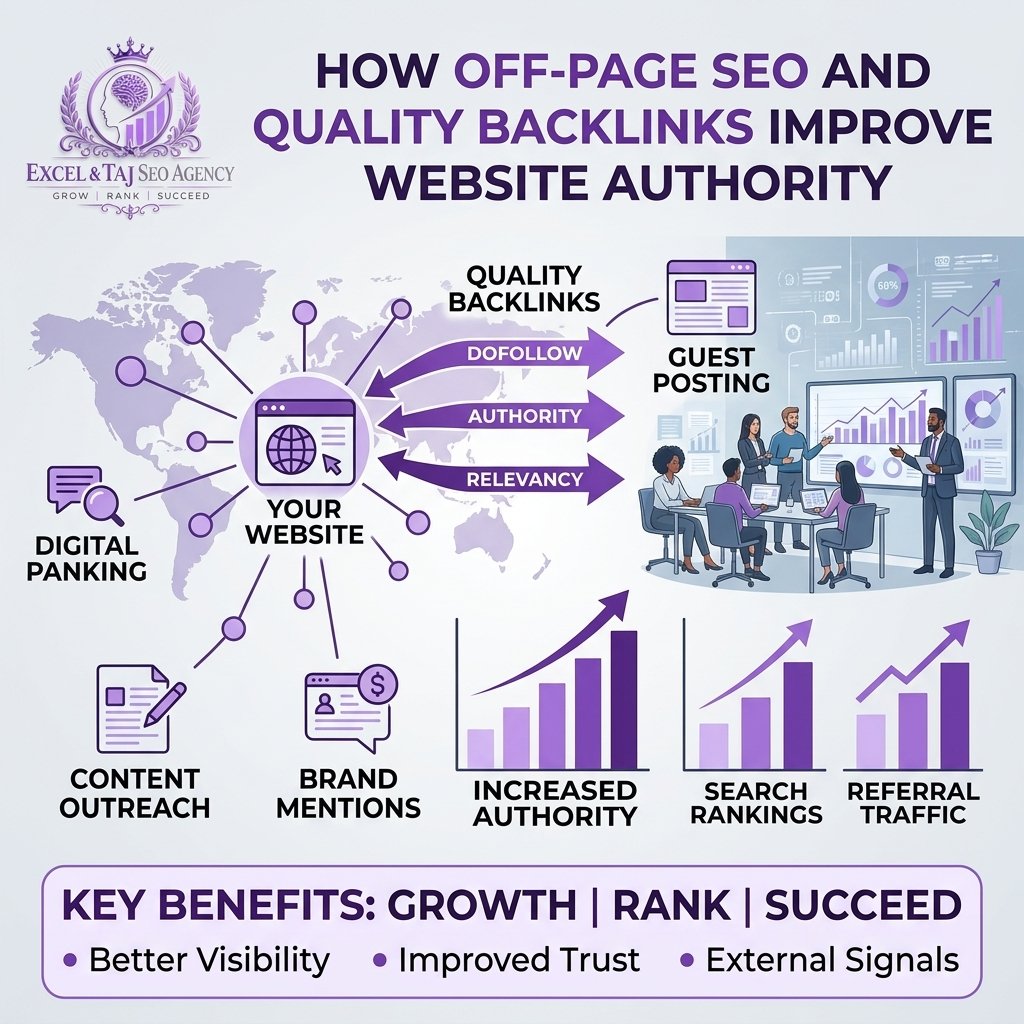
Building a successful website requires more than publishing useful content and optimizing individual pages. In competitive search results, businesses also need to establish credibility, relevance, and authority beyond their own websites. This is where Off-Page SEO becomes an important part of a comprehensive search engine optimization strategy.
Off-Page SEO focuses on activities that take place outside a website and can influence how a brand, website, or page is discovered and perceived across the web. One of the best-known elements of Off-Page SEO is link building, particularly earning relevant and high-quality backlinks from other websites.
However, successful off-page optimization is not simply about collecting as many backlinks as possible. Search engines consider many signals, and relevance, quality, context, and the overall reputation of websites can matter when evaluating links and online authority.
For businesses looking to develop a stronger external SEO strategy, professional Off-Page SEO services can help identify relevant opportunities for link building, content promotion, guest posting, digital outreach, and brand visibility.
This guide explains how Off-Page SEO works, why backlinks matter, what makes a backlink valuable, and how businesses can develop a sustainable strategy for improving their online presence.
What Is Off-Page SEO?
Off-Page SEO refers to optimization activities that take place outside a website and can contribute to its visibility, reputation, and authority.
While On-Page SEO focuses on elements such as content, keywords, headings, titles, and internal links, Off-Page SEO focuses on external signals and relationships.
Common Off-Page SEO activities include:
- Link building
- Guest posting
- Digital PR
- Content outreach
- Brand mentions
- Resource link building
- Online relationship building
- Relevant directory listings
- Content promotion
- Local citations
The purpose is to develop a website’s external presence in ways that are relevant, natural, and valuable.
What Are Backlinks?
A backlink is a link from one website to another.
For example, if Website A publishes an article and includes a relevant link to Website B, Website B has received a backlink from Website A.
Backlinks can help users discover useful resources, and search engines can use links as part of their systems for discovering and understanding websites.
However, not all backlinks are equal.
A link from a relevant, trustworthy website can be more meaningful than a large number of links from unrelated or low-quality websites.
This is why modern link building should focus on quality, relevance, and context rather than quantity alone.
Why Backlinks Matter for Website Authority
Website authority is a broad concept used in SEO to describe the strength, credibility, or reputation associated with a website or domain.
Search engines do not rely on a single public authority score when determining rankings. Instead, they use numerous systems and signals to evaluate webpages and websites.
Relevant backlinks can contribute to the overall external signals surrounding a website.
Quality backlinks may help:
- Increase website discoverability
- Support referral traffic
- Build relationships with relevant websites
- Strengthen brand exposure
- Provide additional pathways for users
- Support broader SEO efforts
Backlinks should therefore be considered as one component of a complete SEO strategy rather than a guaranteed ranking shortcut.
The Difference Between On-Page and Off-Page SEO
Understanding the difference between these two areas makes it easier to develop a balanced SEO strategy.
On-Page SEO
On-Page SEO focuses on elements within your website, including:
- Page titles
- Headings
- Content
- Keywords
- Internal links
- URLs
- Images
- Search intent
- Content structure
Off-Page SEO
Off-Page SEO focuses on external activities such as:
- Backlinks
- Guest posting
- Digital PR
- Outreach
- Brand mentions
- External content promotion
Both areas work together.
A website with excellent backlinks but poor content may struggle to satisfy users. Similarly, a website with excellent content may benefit from external visibility and relevant references.
What Makes a Quality Backlink?
Not every backlink provides the same value.
When evaluating a potential link opportunity, businesses should consider several factors.
1. Website Relevance
Relevance is one of the most important considerations.
A backlink from a website that covers topics related to your industry can make more contextual sense than a link from a completely unrelated website.
For example, a technology company may benefit more from relevant technology, business, software, or entrepreneurship publications than from an unrelated website with no connection to its industry.
2. Content Context
The context surrounding a backlink matters.
A link should ideally appear where it provides useful information to the reader.
For example, an article discussing technical SEO could naturally reference a resource about website optimization.
A contextual link is more useful when it genuinely helps the reader understand the topic.
3. Website Quality
Before pursuing a backlink, it is useful to examine the overall quality of the website.
Consider factors such as:
- Content quality
- Relevance
- Editorial standards
- Organic visibility
- Website activity
- Audience
- Reputation
- Link patterns
Third-party SEO metrics can be useful for research, but they should not be treated as the only measurement of website quality.
4. Editorial Relevance
Editorially relevant links are generally more natural than links placed without context.
A website should link to another resource because it is useful to its audience, not simply because someone wants to manipulate rankings.
5. Potential Referral Traffic
A quality backlink can also provide direct referral traffic.
If readers click a link and visit your website, the backlink has value beyond its SEO role.
This is one reason businesses should consider audience relevance when selecting link opportunities.
Guest Posting as an Off-Page SEO Strategy

Guest posting is a common approach to building relationships and earning relevant links.
Guest posting involves creating original content for another website. The article is published on the host website and may include an appropriate link to a relevant page.
A successful guest post should provide genuine value to the publication’s readers.
Important factors include:
- Relevant website topic
- Original content
- Useful information
- Natural anchor text
- Appropriate link placement
- Editorial quality
- Audience relevance
Businesses should avoid producing low-quality guest posts solely for backlinks.
How to Approach Guest Posting
A practical guest-posting process can include:
- Identify relevant websites.
- Research their audience and content.
- Review their publishing requirements.
- Develop a useful topic.
- Create original content.
- Include relevant links naturally.
- Submit the article according to editorial guidelines.
- Monitor publication and link status.
The goal should be to build a useful resource and a legitimate relationship with the publisher.
Anchor Text and Link Building
Anchor text is the clickable text used in a hyperlink.
For example:
Learn more about Off-Page SEO services
contains the anchor text “Off-Page SEO services.”
Anchor text provides contextual information about the destination page.
However, businesses should avoid using the exact same keyword-rich anchor text across a large number of links.
A natural backlink profile can contain different types of anchor text, including:
- Brand names
- Website names
- Natural phrases
- Partial-match keywords
- Descriptive phrases
- Generic terms where appropriate
The anchor should fit naturally within the surrounding content.
Do-Follow and No-Follow Links
Links can have different attributes that communicate information about how search engines should treat them.
Two commonly discussed attributes are nofollow and sponsored, along with UGC for user-generated content.
A nofollow link can still provide value through referral traffic, visibility, and brand exposure even though it does not function the same way as a traditional followed link for ranking purposes.
Businesses should therefore evaluate links based on their overall usefulness rather than assuming that only one link attribute has value.
Link Building Methods for Modern SEO
There are many ways to develop relevant external links.
Guest Posting
Publishing useful articles on relevant websites can provide exposure and contextual references.
Digital PR
Digital PR can help businesses earn mentions and links through newsworthy campaigns, research, expert commentary, or original data.
Resource Link Building
A business can create useful resources that other websites may naturally want to reference.
Examples include:
- Research reports
- Industry guides
- Statistics pages
- Detailed tutorials
- Original studies
- Useful tools
Broken Link Outreach
Businesses can identify relevant broken links on websites and suggest useful replacement resources when appropriate.
This method should be conducted carefully and should focus on genuine value rather than mass outreach.
Brand Mentions
Sometimes websites mention a company without linking to it.
Where appropriate, businesses can reach out and request a link when the mention is relevant and the publisher is willing to add one.
Competitor Backlink Analysis
Competitor research can help identify potential opportunities for an Off-Page SEO campaign.
A backlink analysis can reveal websites that link to competitors and may also be relevant to your own business.
However, competitor backlinks should not be copied blindly.
A better process is to ask:
- Is the website relevant?
- Does it have a genuine audience?
- Is the content high quality?
- Would a link make sense?
- Is the opportunity editorially appropriate?
The goal is to identify useful prospects, not replicate every link a competitor has.
Digital PR and Brand Visibility
Off-Page SEO is broader than traditional link building.
Digital PR can increase awareness of a business and create opportunities for external mentions.
Potential digital PR activities include:
- Publishing original research
- Providing expert commentary
- Creating industry reports
- Launching useful resources
- Participating in relevant publications
- Sharing newsworthy business developments
When these activities attract genuine attention, they can result in brand mentions, referral traffic, and potentially editorial links.
Local Citations and Off-Page SEO
For local businesses, online business listings and citations can support local search visibility.
A citation may contain information such as:
- Business name
- Address
- Phone number
- Website
- Business category
Consistency is important.
Incorrect or inconsistent business information across important platforms can create confusion for customers and search engines.
Local SEO may also involve:
- Google Business Profile optimization
- Customer reviews
- Local content
- Community relationships
- Local backlinks
Social Media and Off-Page Visibility
Social media links are not simply a substitute for traditional backlinks.
However, social platforms can help businesses distribute content and increase exposure.
A strong social presence can support:
- Content discovery
- Brand awareness
- Audience engagement
- Relationship building
- Content promotion
When useful content reaches the right audience, it may attract attention from publishers, journalists, bloggers, or industry professionals who can independently reference it.
Why Link Quality Is More Important Than Link Quantity
One of the biggest misconceptions in SEO is that more backlinks automatically mean better rankings.
A large number of irrelevant or low-quality links may provide little meaningful value and can create an unhealthy backlink profile.
A quality-focused strategy considers:
- Relevance
- Context
- Website quality
- Editorial standards
- Audience
- Natural placement
For example, ten highly relevant references from respected websites may be more useful from a strategic perspective than hundreds of unrelated links.
The focus should be on building a natural and relevant external presence.
Common Off-Page SEO Mistakes
Buying Low-Quality Links
Purchasing large quantities of low-quality links can create unnecessary SEO risks.
Businesses should focus on legitimate, relevant opportunities.
Excessive Exact-Match Anchor Text
Using the same commercial keyword repeatedly across backlinks can appear unnatural.
Anchor text should vary naturally.
Irrelevant Guest Posting
Publishing articles on unrelated websites simply to obtain backlinks does not create a strong long-term strategy.
Relevance should remain a priority.
Automated Link Building
Automated systems that generate large numbers of artificial links can create low-quality results and may violate search engine guidelines.
Ignoring Website Quality
A backlink should not be evaluated only by a third-party metric.
Review the website itself, its content, relevance, audience, and overall quality.
How to Build a Sustainable Off-Page SEO Strategy
A sustainable campaign can follow a structured process.
Step 1: Define Your SEO Goals
Determine whether the objective is:
- Brand visibility
- Referral traffic
- Organic search growth
- Industry exposure
- Local visibility
- Authority development
Step 2: Analyze the Existing Backlink Profile
Review existing links to understand where they come from and whether they are relevant.
Step 3: Research Competitors
Analyze competing websites to identify potentially relevant publishers and industry resources.
Step 4: Build a Prospect List
Create a list of websites that are relevant to your industry and audience.
Step 5: Create Valuable Content
Develop content that publishers and audiences have a genuine reason to reference.
Step 6: Conduct Personalized Outreach
Contact relevant websites with a clear and professional message rather than sending identical mass emails.
Step 7: Monitor Links and Results
Track published content, backlinks, referral traffic, organic visibility, and other relevant performance indicators.
Step 8: Refine the Strategy
Keep the methods that produce useful results and adjust activities that do not provide meaningful value.
Measuring Off-Page SEO Performance
SEO performance should be measured using multiple indicators rather than a single metric.
Useful measurements may include:
- Referring domains
- Relevant backlinks
- Referral traffic
- Organic impressions
- Organic clicks
- Keyword visibility
- Brand mentions
- Domain-level SEO metrics
- Lead generation
- Conversions
Third-party metrics such as Domain Rating or Domain Authority can be useful for comparative research, but they are not official Google ranking scores.
Businesses should therefore consider multiple signals when evaluating their SEO progress.
How Taj SEO Agency Can Support Off-Page SEO
Building a strong external presence requires research, content, outreach, and ongoing monitoring.
Taj SEO Agency provides SEO-focused services that can be incorporated into a broader search marketing strategy.
Depending on business requirements, an SEO campaign may include:
- Off-Page SEO
- Link building
- Guest posting
- Keyword research
- On-Page SEO
- Technical SEO
- SEO content writing
- Local SEO
- SEO audits
- Digital marketing
A customized approach allows businesses to focus on the areas that are most relevant to their website, industry, audience, and goals.
How Off-Page SEO Works With On-Page and Technical SEO
A strong SEO strategy should not rely exclusively on backlinks.
Imagine a website earns a backlink from a relevant publication, but the destination page loads slowly, has poor content, or does not answer the visitor’s question.
The backlink alone cannot solve those problems.
That is why Off-Page SEO should work together with:
Technical SEO: Ensures the website is accessible, crawlable, and technically healthy.
On-Page SEO: Optimizes individual pages, content, keywords, headings, and internal links.
Content SEO: Creates useful resources that satisfy search intent.
Off-Page SEO: Builds relevant external relationships, mentions, and links.
When these areas are aligned, businesses can develop a more complete SEO foundation.
Long-Term Benefits of a Quality Off-Page Strategy
A thoughtful Off-Page SEO strategy can contribute to several areas of digital marketing.
Greater Brand Exposure
Publishing content on relevant websites can introduce a brand to new audiences.
Referral Traffic
Useful backlinks can send interested visitors directly to your website.
Stronger Industry Relationships
Outreach and guest posting can help businesses build relationships with publishers and industry professionals.
Increased Content Discovery
External references can help more people discover valuable resources.
Broader Online Presence
Consistent brand mentions and relevant publications can strengthen a company’s presence across the web.
Conclusion
Off-Page SEO plays an important role in building a website’s external presence and supporting long-term search visibility. While backlinks remain a significant part of off-page optimization, successful SEO is not about collecting as many links as possible.
The strongest approach focuses on relevance, quality, context, editorial value, and genuine usefulness.
From guest posting and digital PR to relevant link building, brand mentions, content promotion, and local citations, businesses can use a range of strategies to build relationships and increase their visibility beyond their own websites.
Professional Off-Page SEO services from Taj SEO Agency can help businesses develop a structured approach to external SEO while coordinating off-page activities with technical, on-page, and content optimization.
Ultimately, a successful SEO strategy should focus on creating something worth discovering and referencing. When high-quality content, a technically sound website, and relevant external promotion work together, businesses can build a stronger foundation for sustainable organic growth.
Frequently Asked Questions
1. What is Off-Page SEO?
Off-Page SEO refers to activities performed outside a website to support its online visibility, reputation, and authority. Common activities include link building, guest posting, digital PR, brand mentions, outreach, and local citations.
2. Are backlinks important for SEO?
Backlinks can be an important part of SEO because they can help users discover content and provide external signals about websites and webpages. However, the quality and relevance of backlinks are more important than simply acquiring a large number of links.
3. What makes a backlink high quality?
A quality backlink generally comes from a relevant and credible website, appears in an appropriate context, and provides genuine value to the audience. Businesses should also consider the website’s content quality, audience, editorial standards, and overall reputation.
4. Is guest posting still useful for SEO?
Guest posting can be useful when it involves original, valuable content published on relevant websites. It should not be used as a method for mass-producing low-quality articles solely to obtain backlinks.
5. How long does Off-Page SEO take to show results?
There is no fixed timeline. Results can vary depending on the website’s existing authority, competition, content quality, link acquisition, industry, and overall SEO strategy. Off-Page SEO generally works best as a consistent, long-term activity rather than a short-term campaign.